The Turoe Stone
Six kilometres north of Loughrea, off the R350 at Bullaun, a rounded granite stone a little over a metre tall carries the finest Celtic carving in Ireland: a continuous, flowing, abstract design in the La Tène style over its upper half, cut somewhere between 100 BC and AD 100. This is the Turoe Stone, National Monument number 327, usually on the lawn of Turoe House inside a cattle grid.
Checked against the source on 2026-09-19.
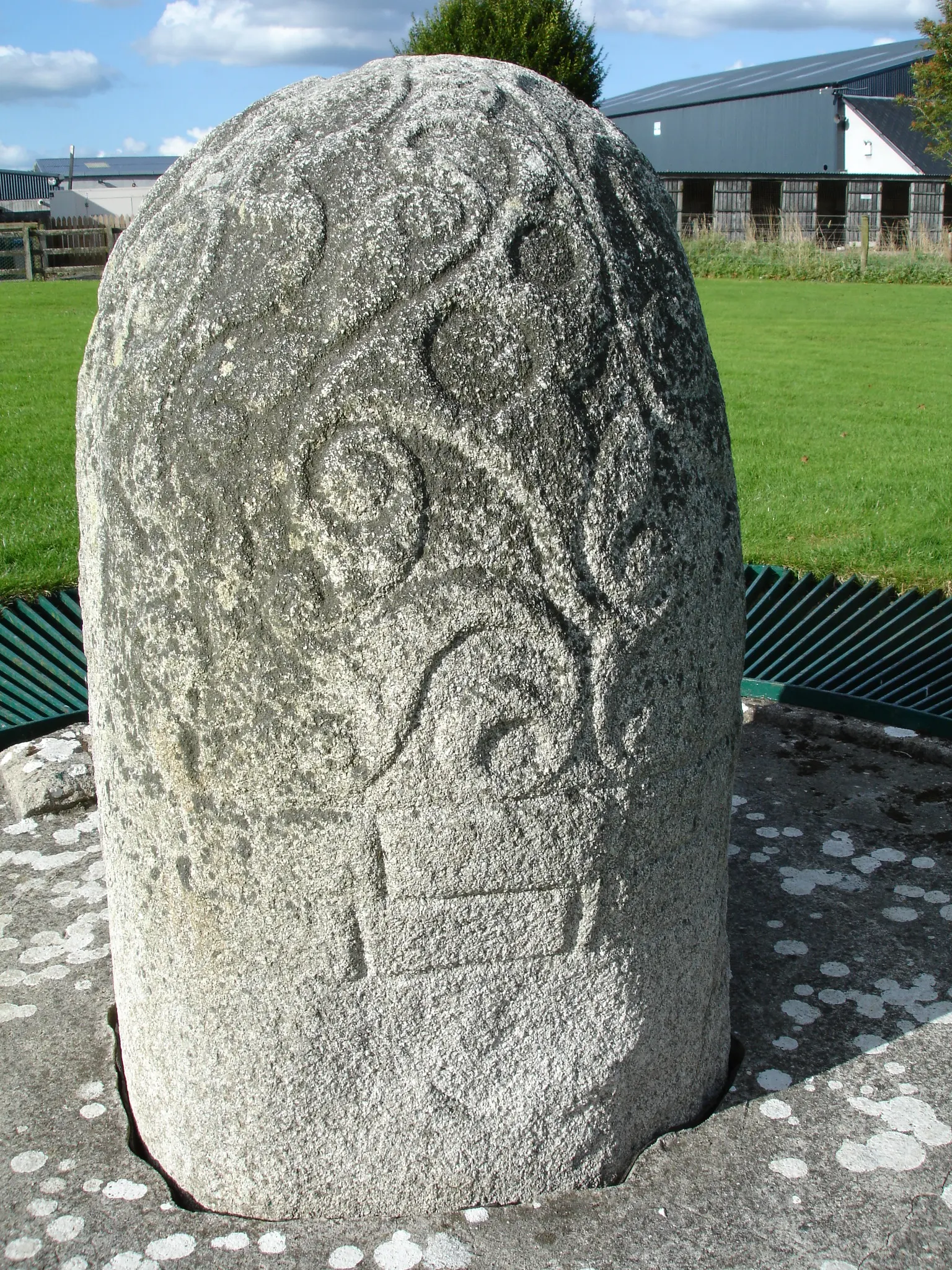
Dirk Huth, CC BY-SA 3.0 via Wikimedia Commons

Turoe Stone on the 3D model; tap a pin for its page and directions.
What it is
The carving is curvilinear and abstract, close in spirit to the Castlestrange Stone in Roscommon. What the stone was for is lost; it is best understood as a ritual stone, perhaps used in ceremonies such as the handing over of power. For centuries it stood at a lios, a fairy fort, about three kilometres from Bullaun, and George Coffey, writing for the Royal Irish Academy in 1904, said it had been moved in the 1850s from the rath of Feerwore, Ráth Férach Mhór, at the top of Turoe hill. Excavation there found much material suggesting an open site of the late centuries BC later enclosed. The move to the farm destroyed its historic setting.
Arguments over where it belongs
In 1967 the stone went temporarily to Dublin for the ROSC art exhibition, and Niall Montgomery of the Royal Institute of the Architects of Ireland resigned from the National Monuments Advisory Council over it. A 2007 proposal to remove it from Turoe because the weather was wearing it met fierce local opposition. As of 2025 it had been moved temporarily to an Office of Public Works depot in Athenry for conservation, so check before you drive out.
Questions people ask
Where is the Turoe Stone?
How old is the Turoe Stone?
What was the Turoe Stone used for?
Written from Wikipedia, "Turoe Stone" (CC BY-SA 4.0), read on 2026-09-19, and from the OpenStreetMap places on the model. Nothing has been added from memory; follow the source for its footnotes.