Omey Island
At low tide a line of arrowed signs leads across a wide sandy strand from Claddaghduff to an island that, from the mainland, you can hardly tell is there. This is Omey, Iomaí, Feichin's resting place: a monastery from the early sixth century, a church that the sand swallowed and gave back, a graveyard still in use, and a beach that becomes a racecourse once a year. At high tide the water over the strand is deep enough to cover a car, so read the tide table first.
Checked against the source on 2026-09-19.
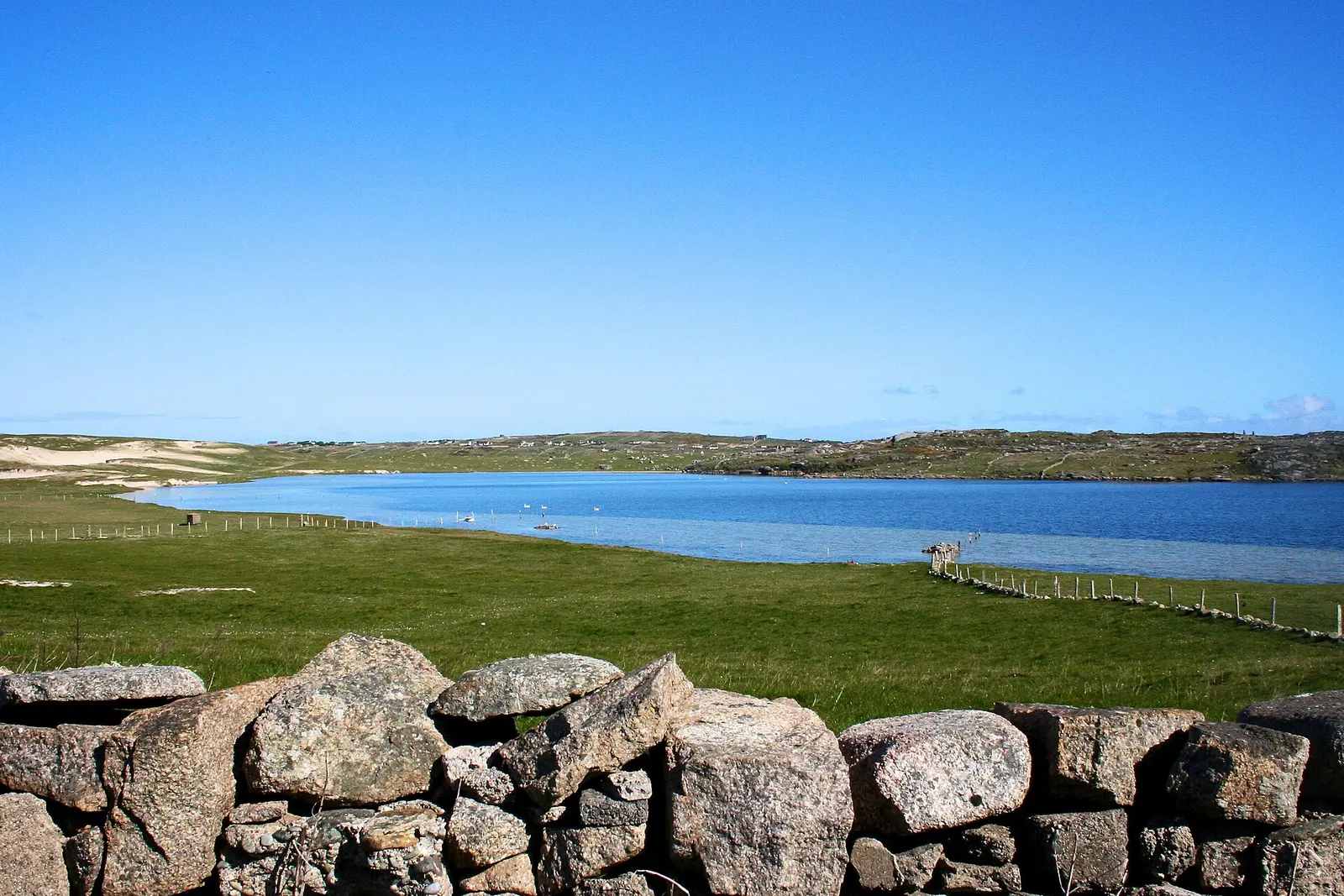
Markbriggs, CC BY-SA 3.0 via Wikimedia Commons

Teampall Feichin on the 3D model; tap a pin for its page and directions.
Feichin's island
The name comes from Iomaidh Feichín, Feichin's bed or seat. In the early 1990s archaeologists from University College Dublin began studying the monastic site, which is believed to date from the early sixth century; their excavation found one of the few known burials of a woman inside an Irish monastic graveyard. St Feichin's well with its small shrine stands at the western edge, and Teampaill Feichin, the medieval parish church built on the abbey's site, was excavated from the sand in 1981 with most of its stones still in place. Shell middens around the island have been carbon-dated to between AD 1000 and 1500. From the north-west shore High Island and Fair Island, both with monastic remains, are in view.
O'Tooles, Martins and a bishop
The O'Tooles of Leinster settled here in the early 1500s under the O'Flahertys' protection; the Cromwellian settlement gave the island to the Brownes and D'Arcys, and by the early 1800s two townlands belonged to the Martins of Ballynahinch and one to the D'Arcys of Clifden. Duffy's Hibernian Magazine described it then as a flat, unpicturesque abode of misery with half its surface lough and marsh. John MacNeice, the Church of Ireland bishop who stood against the Ulster Covenant, was born and raised on Omey.
Down to three households
Hundreds of people lived on Omey in the early nineteenth century. The national school opened in 1883 and closed in 1973, and by 1988 three households remained. For more than thirty years the only full-time inhabitant was Pascal Whelan, a former stuntman and wrestler, who died in February 2017. The poet Richard Murphy lived here for a time and built an octagonal retreat that still stands; in 2003 the artist Sean Corcoran reported a creature in the lake that he compared to the dobhar-chú, the master otter of legend. The graveyard, Ula Bhreandain, is still used, and the Omey Races, revived in 2001, run on the strand each year.
Questions people ask
How do you get to Omey Island?
Does anyone live on Omey Island?
What is there to see on Omey?
Written from Wikipedia, "Omey Island" (CC BY-SA 4.0), read on 2026-09-19, and from the OpenStreetMap places on the model. Nothing has been added from memory; follow the source for its footnotes.