The Battle of Aughrim
On the ridge above the village of Aughrim, between Loughrea and Ballinasloe, the Williamite war in Ireland was decided in an afternoon. On 12 July 1691, old style, the Jacobite army of James II met the army of William III, about twenty thousand men a side, and by nightfall some seven thousand were dead, more than in any other battle ever fought in Britain or Ireland. Eachdhroim an áir, tradition calls it: Aughrim of the slaughter.
Checked against the source on 2026-09-19.
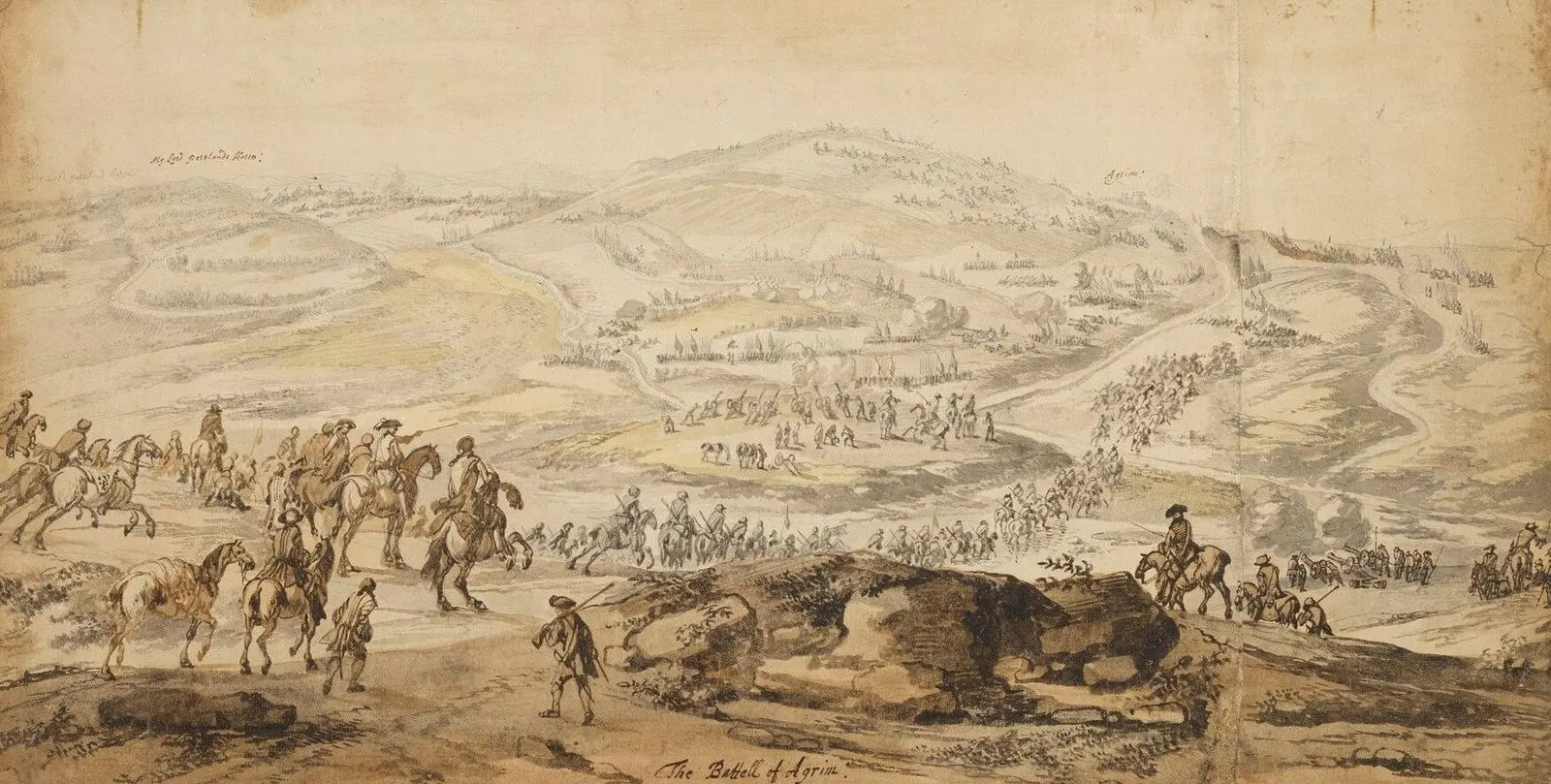
Jan Wyk, public domain via Wikimedia Commons

Battle of Aughrim Interpretative Centre, The bloody Hollow on the 3D model; tap a pin for its page and directions.
Behind the Shannon
By 1691 the Jacobites were on the defensive. They had fallen back into Connacht behind the Shannon the year before, with Sligo, Athlone and Limerick guarding the ways in, and William's siege of Limerick in August 1690 had failed with heavy losses to wounds and disease. But James had gone to France after the Boyne, and his command was split between a peace party under his viceroy Tyrconnell, who wanted to negotiate, and a war party of officers around Patrick Sarsfield. The army had been rebuilt from James's old Irish army, purged of most Protestant officers and men from 1686 and swollen with new Catholic regiments; at least thirty foot regiments have been identified as likely present, with about 4,000 cavalry and dragoons, far better trained and armed than the infantry.
The afternoon of 12 July
Mist lay over the ground all morning. Ginkel's forces were in position by about two, and the guns of both sides fired for hours. Ginkel meant to wait for the next day, and sent only a probe against the weaker Jacobite right, a captain with sixteen Danish troopers and then two hundred of Cunningham's Enniskillen dragoons. The Jacobite reply showed how strong their line was, but it also meant the attackers could not break off, and at a council about four o'clock Ginkel still wanted to withdraw while the infantry general Hugh Mackay argued for a full attack. Between five and six the battle was joined in earnest.
The Williamites claimed afterwards to have lost only 600 and killed 7,000; modern studies put their dead at one to two thousand, some as high as three, and the Jacobite dead at about four thousand, with another four thousand deserting and 526 prisoners taken. Ginkel had promised that captives would be treated as prisoners of war. The Jacobite defeat ended James's cause in Ireland in effect, though Limerick held until the autumn.
The unburied and the centre
Ginkel had his own dead buried and left the Jacobites where they fell; their bones lay on the field for years. Séamas Dall Mac Cuarta wrote of Aughrim of the slaughter, where their damp bones lie uncoffined, and John Dunton, travelling seven years later, recorded that the English had buried none but their own. The Battle of Aughrim Interpretative Centre in the village, opened in 1991 by the Aughrim Heritage Committee with Ireland West Tourism and the county council, holds artefacts from the field, three-dimensional displays and a film on the battle and its place in Irish history. The model on this page pins the centre and the Bloody Hollow.
Questions people ask
When was the Battle of Aughrim?
How many died at Aughrim?
Why did the Battle of Aughrim matter?
Is there a visitor centre at Aughrim?
Written from Wikipedia, "Battle of Aughrim" (CC BY-SA 4.0), read on 2026-09-19, and from the OpenStreetMap places on the model. Nothing has been added from memory; follow the source for its footnotes.