Ross Errilly Friary
A mile north-west of Headford, on the Black River where Galway meets Mayo, stands the most complete medieval friary in the country. Ross Errilly, Mainistir an Rois, is called Ross Abbey by everyone local though it never had an abbot: a Franciscan house of the mid-fifteenth century with its church, bell tower, two cloisters, kitchen, bakehouse, refectory and dormitories all still standing to the roofline. It is a National Monument, open and free.
Checked against the source on 2026-09-19.
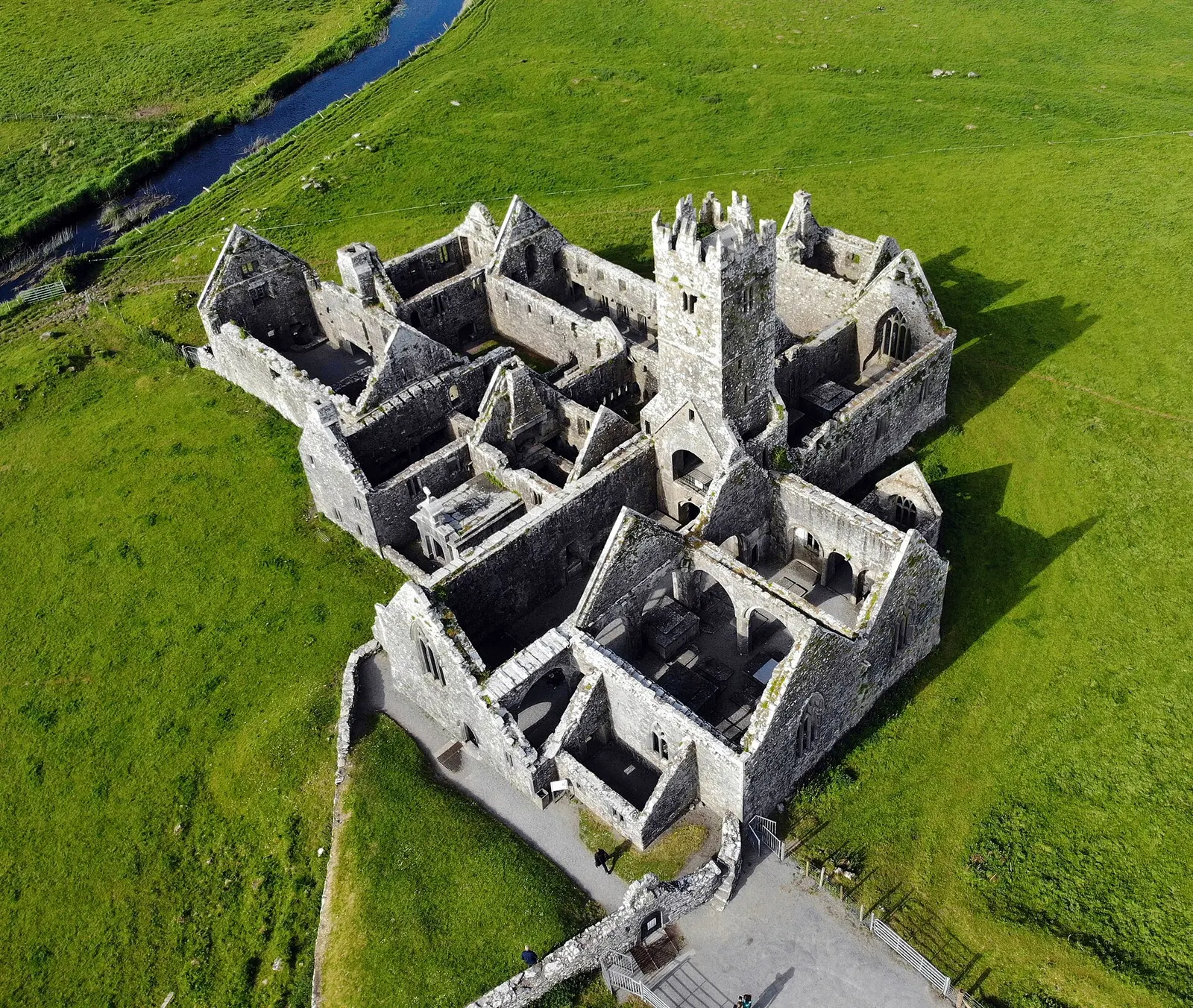
Evan Williams, CC BY-SA 4.0 via Wikimedia Commons

Ross Errilly Friary, Killursa Church on the 3D model; tap a pin for its page and directions.
Founded about 1460
Luke Wadding and the Four Masters both put the foundation at 1351, but the architecture and the documents point to the middle of the fifteenth century, perhaps around 1460; the earliest record is the will of John Blake of Galway, who left the friary forty pence in 1469. Whatever stood here before was greatly enlarged in that century. Around 1473 friars from Ross Errilly went north at the Tyrconnell clan's request and founded the Donegal friary.
The plan is unusual for its second cloister, built to house a growing community. The kitchen keeps its oven and a water tank for live fish; the refectory and bakehouse stand beside it, the dormitories above. The church has been a burial ground for the district ever since, with tombs from the friary's own time and graves from the eighteenth to the twentieth centuries inside its walls.
Evicted, and back again
The Franciscans had opposed Henry VIII's break with Rome, and in 1538 the English authorities imprisoned two hundred of the friars and banished or killed others. Under Elizabeth the friary was confiscated and given to Richard Burgh, second Earl of Clanricarde, whose ancestors had helped found it; he quietly gave it back, and in 1572 a ditch and wall were built around it. In 1584 the crown seized it again and gave it to an English noble who evicted the friars and plundered the buildings.
On 18 February 1642 Ulick Burke and the friars rescued some forty Protestant refugees, the family of Bishop John Maxwell of Killala among them, after their Catholic escort massacred the rest of the party from Shrule, perhaps 65 people; the survivors were sheltered in Headford until they could be sent to England. Under Cromwell the friary became a refuge for clergy driven out of the rest of Ireland. The Popery Act of 1698 put a bounty on priests and the friars fled again; they were back by 1712, gone in 1731, back by 1753 under the secret protection of Lord St George, who risked life imprisonment for it until a family that had lost a lawsuit to him informed on him.
Skulls, ivy and the Quiet Man
The roof fell in 1812. In 1835 the English traveller John Barrow called it a remarkably fine old ruin in a disgracefully neglected state and was astonished by the moss-grown skulls and leg bones strewn so thickly that he could not step without treading on them; Samuel Lewis in 1837 found it partly covered in ivy with one window still perfect; William Wilde in 1866 found the heaps of bones still there. Today the Office of Public Works maintains it and it is open free of charge. John Ford filmed part of The Quiet Man here in 1952, and the television series Reign and the films Moving Target, The Suicide Club and Bad Karma followed.
Questions people ask
Is Ross Errilly Friary free to visit?
When was Ross Errilly founded?
Where is Ross Errilly?
Was The Quiet Man filmed at Ross Errilly?
Written from Wikipedia, "Ross Errilly Friary" (CC BY-SA 4.0), read on 2026-09-19, and from the OpenStreetMap places on the model. Nothing has been added from memory; follow the source for its footnotes.