Glengowla Mines
A few kilometres west of Oughterard, a farmer turned up galena, lead ore, just under the surface of his land in 1851. The shaft that followed, named after a Captain Paul, was worked for fourteen years, and what the miners left is now Glengowla Mines, a show mine where you go underground into the nineteenth-century workings and come up to a blacksmith's shop and a round powder house.
Checked against the source on 2026-09-19.
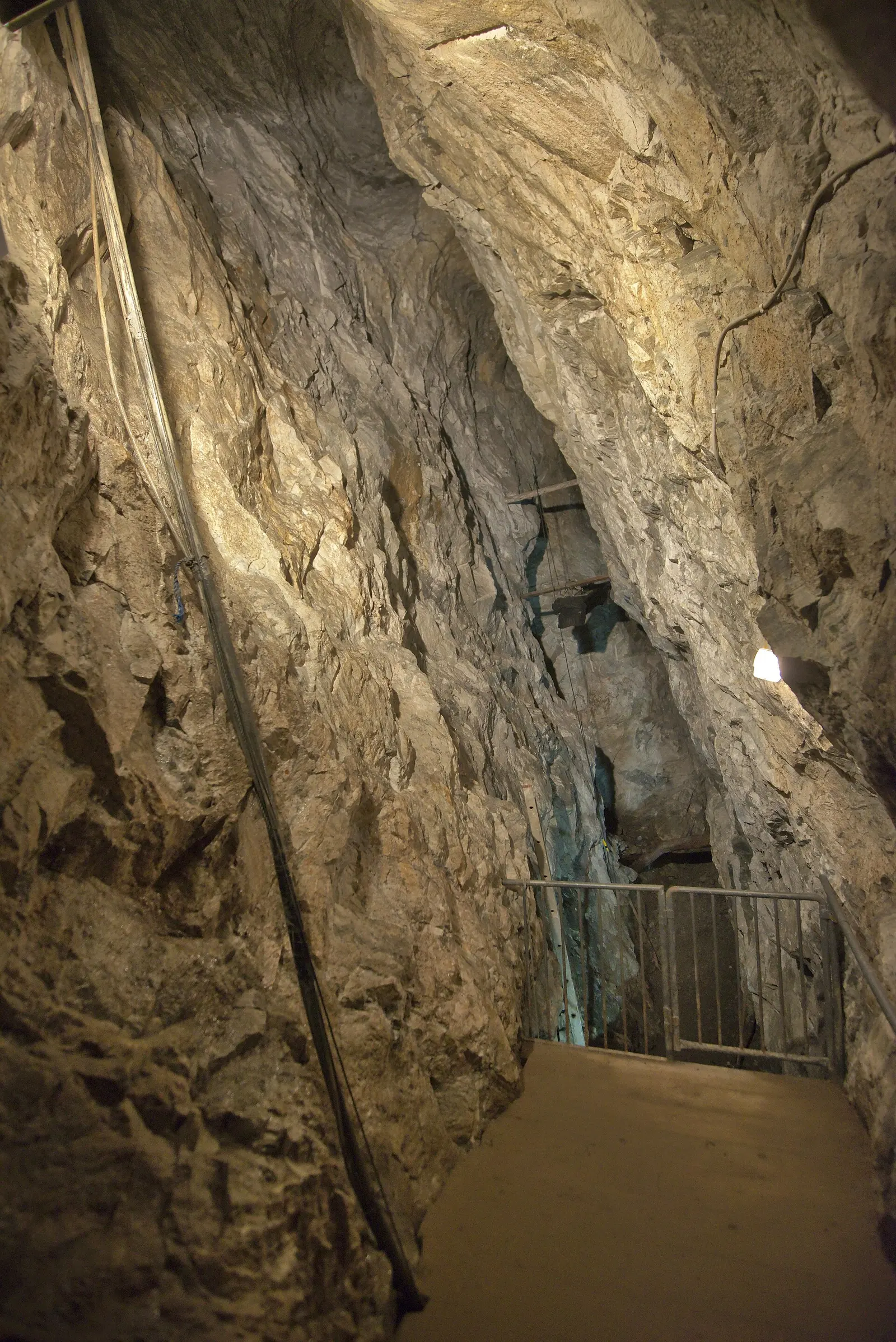
andrew mcmillan, CC BY 3.0 via Wikimedia Commons

Glengowla Mines, Glengowla Mines Museum on the 3D model; tap a pin for its page and directions.
Fourteen years of lead and silver
Mining began in 1851 and ran until 1865, by which time the working measured 40 metres deep and 200 feet wide. Silver and lead were the point of it, but the ground also gave Connemara marble, gold, dolerite, quartz and rare green and blue octahedral fluorite.
The show mine
The landowners Patrick and Keith Geoghegan opened the site as a heritage attraction. The nineteenth-century mine has been restored so that visitors can go in, and above ground there is a heritage and visitor centre, a blacksmith's shop and a circular powder house where the explosives were kept. Glengowla also has a seismograph and is part of Ireland's National Seismic Network, logging tremors in real time and adding to the record of earthquakes worldwide. The model on this page pins the mine and the museum.
Questions people ask
When was Glengowla mined?
What was mined at Glengowla?
What is at Glengowla Mines today?
Written from Wikipedia, "Glengowla Mines" (CC BY-SA 4.0), read on 2026-09-19, and from the OpenStreetMap places on the model. Nothing has been added from memory; follow the source for its footnotes.