The Tuam Mother and Baby Home
For thirty-six years the building that had been Tuam's famine workhouse held unmarried mothers and their children. The Bon Secours Sisters ran it for the county council from 1925 to 1961, and it was known in the town simply as the Home. In 2013 a local historian, Catherine Corless, paid for a registrar to pull the death certificates of every child recorded as dying there. There were 796. Most of them have no known grave, and the work of finding them is under way on the site now.
Checked against the source on 2026-09-19.
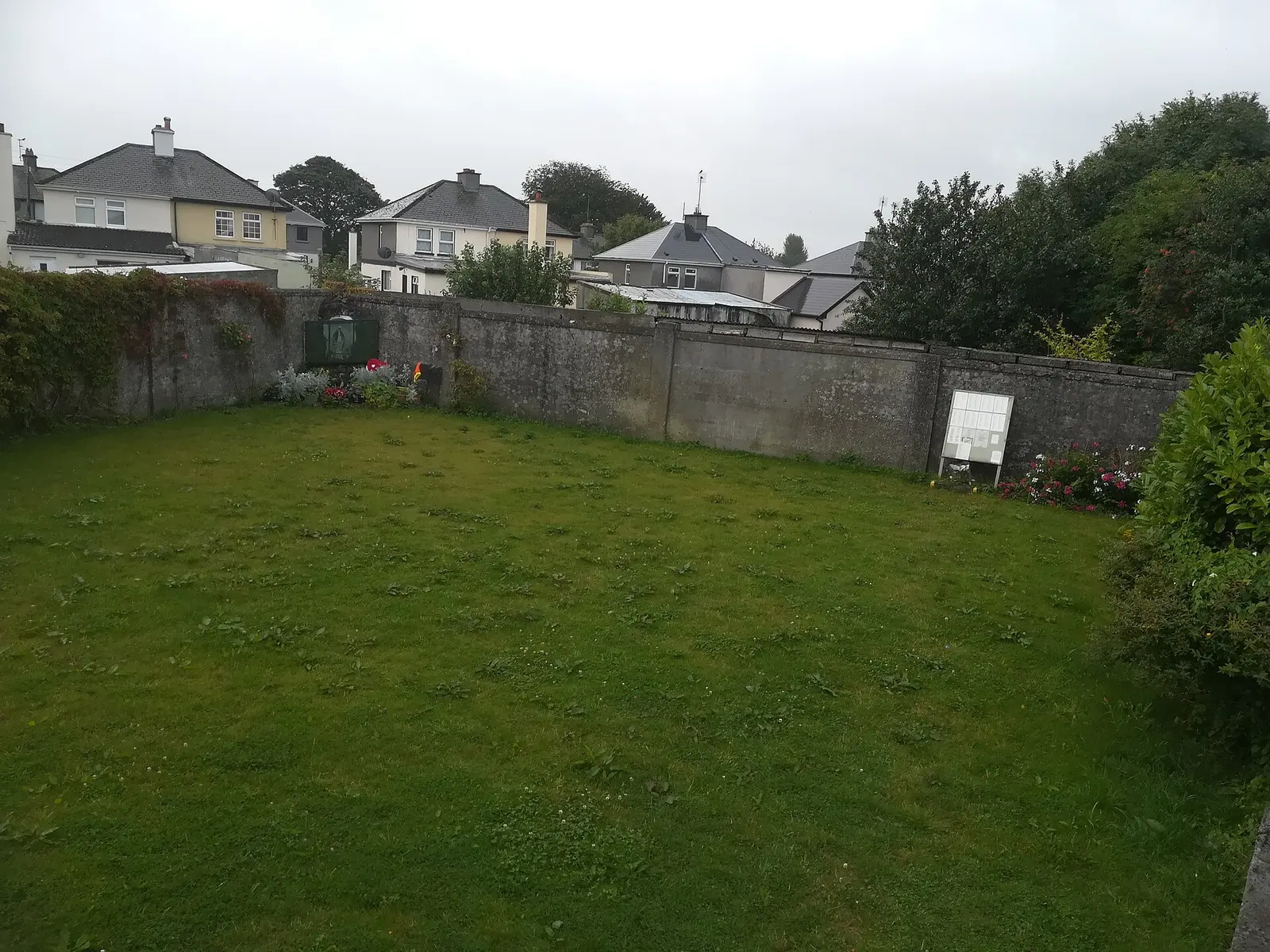
AugusteBlanqui, CC BY-SA 4.0 via Wikimedia Commons

Tuam High Cross, Cathedral of the Assumption of the Blessed Virgin Mary on the 3D model; tap a pin for its page and directions.
Workhouse, barracks, Home
The workhouse was built in 1841 to George Wilkinson's standard design for about 800 people and opened in 1846, in the worst of the Famine, with an infirmary, sheds for fever cases and later a fever hospital. It served as a military barracks before the Bon Secours Sisters, led by Mother Hortense McNamara, took it over in 1925 at the request of the local authority after the county's workhouses closed. Unmarried women were sent here to give birth; the sisters were unlikely to include midwives, since the papal ban on nuns attending births lasted until 1936, and in 1927 the Board of Health ordered a maternity ward added.
1975, 2012, 2014
In 1975 two boys of ten and twelve, Franny Hopkins and Barry Sweeney, lifted a concrete slab on the old site and found a chamber full of children's skeletons; the slab was thought to cover the Home's septic tank, people guessed at famine victims, and it was resealed after prayers. Corless published her research in the Journal of the Old Tuam Society in 2012, and the certificates she obtained in 2013 gave causes of death including tuberculosis, convulsions, measles, whooping cough, influenza and malnutrition. In May and June 2014 Alison O'Reilly's report in the Irish Mail on Sunday carried the story around the world; the Gardaí at first called the bones historical famine burials, and on 4 June 2014 the government set up an inquiry.
What the Commission found
On 3 March 2017 the Mother and Baby Homes Commission of Investigation announced that a test excavation between November 2016 and February 2017 had found human remains aged from 35 foetal weeks to two or three years, dating from the 1920s to the 1950s, in an underground structure of twenty chambers. Taoiseach Enda Kenny called the Home a chamber of horrors. The Commission's final report, published on 12 January 2021, found that 9,000 children had died in the 18 institutions it examined between 1922 and 1998, one in seven, at almost double the general infant mortality, and that before 1960 the homes appear to have reduced rather than saved the lives of children born outside marriage. The Bon Secours Sisters apologised in 2021, saying they had not lived up to their Christianity in running the Home.
The excavation
In December 2017 an expert group led by the forensic archaeologist Dr Niamh McCullagh set out five options, and on 23 October 2018 the government chose full forensic excavation under a humanitarian forensic approach: phased recovery, analysis and where possible identification of remains, and respectful reburial. The Institutional Burials Act 2022 made it lawful, the Office of the Director of Authorised Intervention at Tuam was set up in March 2023 under Daniel MacSweeney, works began on 16 June 2025 and full-scale recovery started on 14 July 2025. Corless received the Bar Council's Human Rights Award in 2017, and the 2017 New York Times story The Lost Children of Tuam became a film in 2026, produced by Liam Neeson with Monica Dolan as Corless. Residents have also asked for the town's Grove Hospital, run by the same order, to be investigated, and the county council requires an archaeologist to monitor any digging there.
Questions people ask
How many children died at the Tuam Mother and Baby Home?
Has the Tuam site been excavated?
Who ran the Tuam Home?
Who is Catherine Corless?
Written from Wikipedia, "Bon Secours Mother and Baby Home" (CC BY-SA 4.0), read on 2026-09-19, and from the OpenStreetMap places on the model. Nothing has been added from memory; follow the source for its footnotes.