Claregalway Friary
On the bank of the Clare, beside the bridge into the village, the tower of Claregalway Friary rises 24 metres over a roofless church. John de Cogan founded it for the Franciscans around 1240, and his grandson gave the friars the building and its lands in 1327 for a rent of one rose a year, to be presented on the feast of John the Baptist.
Checked against the source on 2026-09-19.
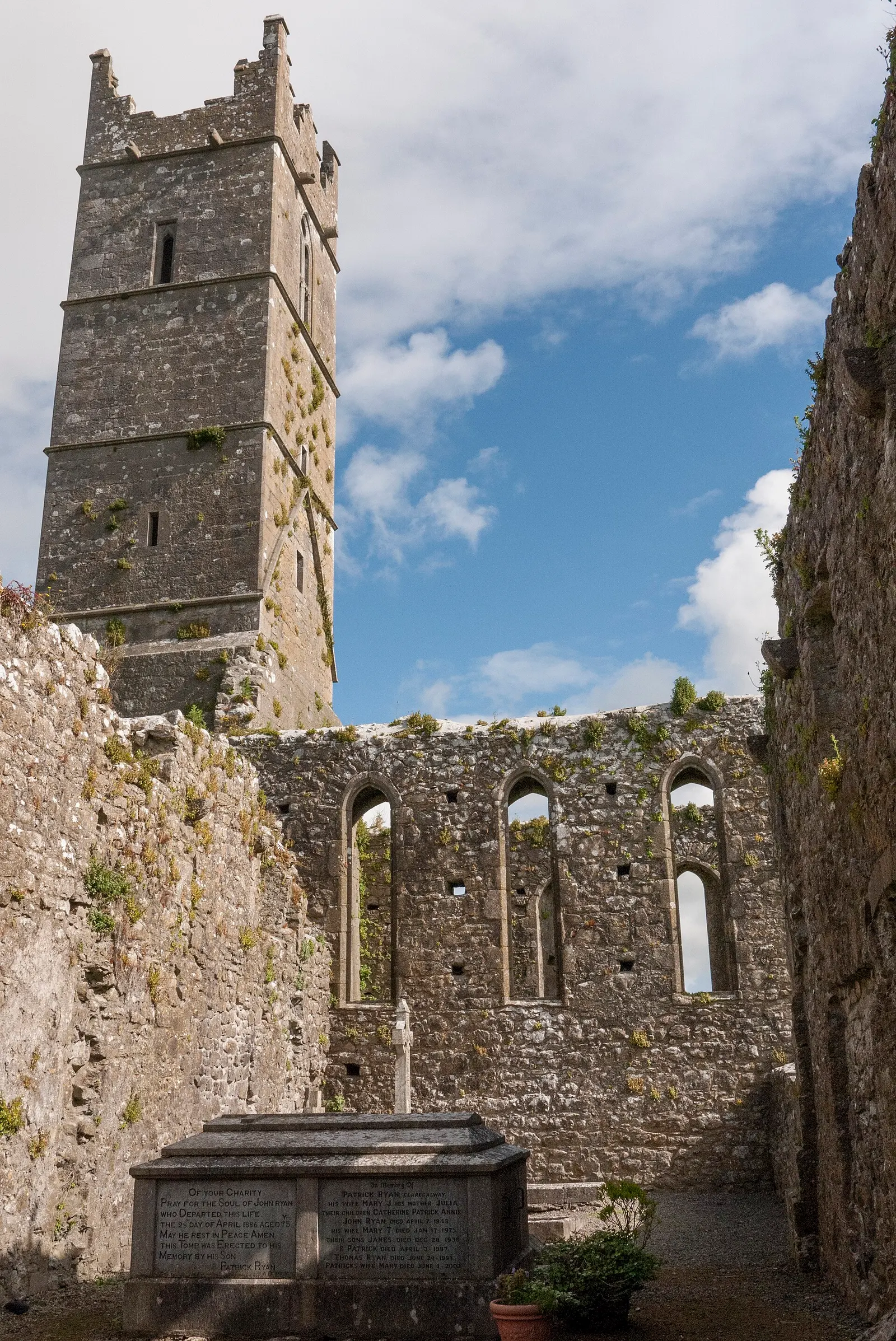
Matheus Muñoz, CC BY 4.0 via Wikimedia Commons

Claregalway Friary, Claregalway Castle on the 3D model; tap a pin for its page and directions.
A rose a year
The friary was certainly standing by 1250. Some sources credit John de Cogan II with founding it, but it was his father, John de Cogan I. In 1326 John Magnus de Cogan, the third John, called himself the founder, which is read either as patronage or as a great enlargement; in 1327 he handed the friars the building and the land around it, asking in return that they present a rose to him and his heirs each year on the Nativity of John the Baptist. The house was renovated in the fifteenth century, when the tower went up.
What stands
The church faces east and is cruciform, missing its south transept, with the bell tower at the crossing; the living quarters and cloister lie to the south. An aisle of four pointed arches on round pillars with simple moulded capitals was added to the nave. Two archbishops of Tuam are buried here: Muiris Ó Fithcheallaigh, the Franciscan theologian, who died in 1513, and Tomás Ó Maolalaidh, who died in 1536. The castle, the sixteenth-century tower house, stands a few hundred metres away, and the model on this page pins both.
Questions people ask
When was Claregalway Friary founded?
How tall is the tower at Claregalway Friary?
Who is buried at Claregalway Friary?
Written from Wikipedia, "Claregalway Friary" (CC BY-SA 4.0), read on 2026-09-19, and from the OpenStreetMap places on the model. Nothing has been added from memory; follow the source for its footnotes.