Inishbofin
Eight kilometres off Cleggan, across the mouth of Ballynakill Harbour, lies an island of about 180 people, no trees, one football pitch, three hotels and fourteen centuries of history. Inishbofin, Inis Bó Finne, the island of the white cow, is where St Colmán came from Lindisfarne in the 660s, where Cromwell's soldiers kept a prison for priests, and where the ferry from Cleggan lands you in the harbour under the barracks.
Checked against the source on 2026-09-19.
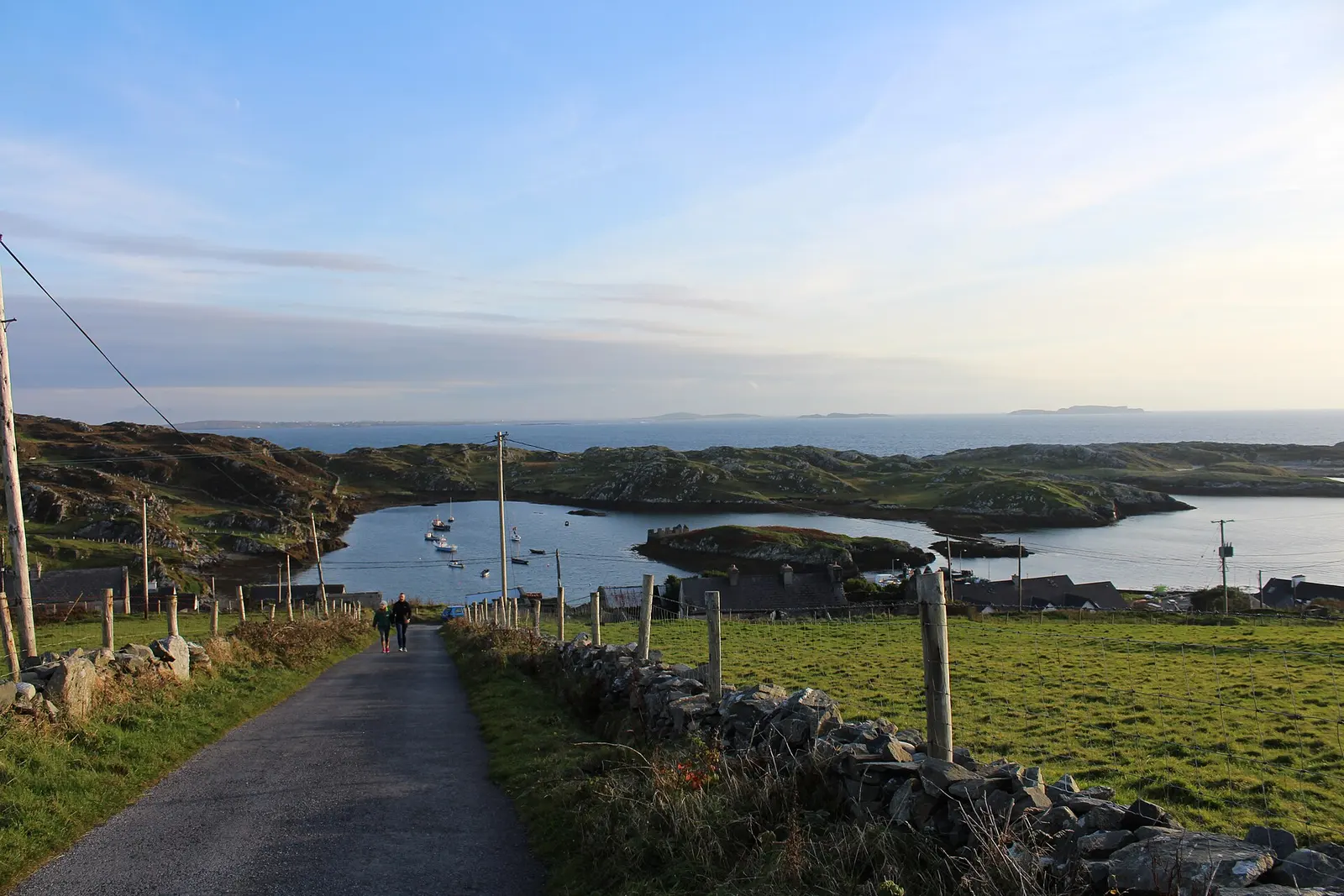
Towel401, CC BY-SA 4.0 via Wikimedia Commons

Cromwell's Barracks, Inishbofin Signal Tower, Cleggan on the 3D model; tap a pin for its page and directions.
A floating island fixed by fire
The legend is that the island floated until fishermen landed in a fog and lit a fire, which broke the spell; then they saw an old woman driving a white cow, and when she struck it with her stick it turned to stone. The island is 5.5 kilometres by 3, rising to 89 metres in the Westquarter, with Inishark across a narrow channel. Much of it is a Special Area of Conservation for corncrakes and seals. There are no trees: the wood was burned for fuel and the salt air never let it grow back.
Colmán, Vikings and Cromwell
The first sure traces of people are Iron Age promontory forts such as Dún Mór; there are prehistoric field systems whose age is uncertain. Around 665, or 668 by the annals, Colmán of Lindisfarne founded a monastery here and died on the island in 675; the Vikings plundered it in 795, and the annals name its abbots into the tenth century. The ruined thirteenth-century church in St Colmán's cemetery stands on the monastery's site. Cromwell's barracks guard the harbour mouth. In 1890 the academics Alfred Haddon and Andrew Dixon took the skulls and bones of thirteen people from the monastery graveyard by night for craniometry; Trinity College kept them until 2023, when islanders petitioned for their return and the provost apologised.
The island today
In 1837 there were 1,462 people; 959 by 1881; about 200 in 1990 and 160 at the 2011 census. Tourism is the living now: three hotels and a hostel, scuba diving, walking trails, cycling, horse riding, sailing, paddle boarding, kayaking, snorkelling and angling from shore and boat. The island hosted the All-Ireland islands football tournament in 2008 and 2017, and Galway's senior goalkeeper Ruairi Lavelle is an islander. The light on Gun Rock, built in 1909, was swept away by a storm on 3 January 2014. Seamus Heaney's poem Seeing Things opens with the boat ride out: sunlight, turfsmoke, seagulls, boatslip, diesel.
Questions people ask
How do you get to Inishbofin?
How many people live on Inishbofin?
What is there to see on Inishbofin?
Written from Wikipedia, "Inishbofin, County Galway" (CC BY-SA 4.0), read on 2026-09-19, and from the OpenStreetMap places on the model. Nothing has been added from memory; follow the source for its footnotes.