Cong Abbey
Five kilometres from Clonbur, in the village of Cong just over the Mayo line, the ruined abbey by the river holds some of the finest early Gothic stonework in the country. A church stood here in the seventh century; the High King Turlough O'Connor refounded it in the 1130s for the Augustinians, and his son Rory, the last High King of Ireland, built here and spent his last fifteen years within its walls.
Checked against the source on 2026-09-19.
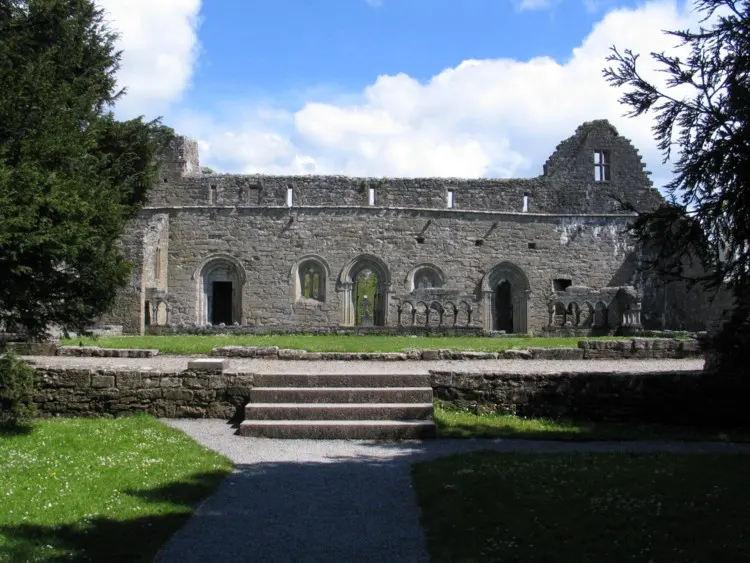
No machine-readable author provided. Christian1965~commonswiki assumed (based on, public domain via Wikimedia Commons

Cong Abbey, Ashford castle on the 3D model; tap a pin for its page and directions.
From Feichin to the O'Connors
St Feichin is said to have built the first church here in the early seventh century. A later building burned in 1114, and within twenty years Turlough Mór O'Connor, High King of Ireland, refounded the abbey; raiders from Munster wrecked it in 1137 and he rebuilt it, and in 1138 it was refounded for Augustinian canons, among the earliest Augustinian houses south of Armagh. In 1198 his son Ruaidrí, Rory O'Connor, put up new buildings and lived out his last fifteen years here; he died in the abbey and was buried briefly there before being moved to Clonmacnoise.
The stonework
What stands is mostly the rebuilding of the early thirteenth century: the church, and possibly the fragmentary cloister where the canons worked and prayed. The north doorway of the church and the elaborate doorways from the cloister into the east range may be older than William de Burgo's attack. The doorway with two fine windows on either side is the chapter house, where the day's business was done, a chapter of the rule was read and the community confessed its faults in public. The sculpture is among the finest in Ireland. The abbey is a national monument in the care of the Office of Public Works.
Questions people ask
Who founded Cong Abbey?
Is Cong Abbey in Galway?
Where was Rory O'Connor buried?
Written from Wikipedia, "Cong Abbey" (CC BY-SA 4.0), read on 2026-09-19, and from the OpenStreetMap places on the model. Nothing has been added from memory; follow the source for its footnotes.