Galway Cathedral
The green dome on the west bank of the Corrib belongs to Galway Cathedral, the Cathedral of Our Lady Assumed into Heaven and St Nicholas. It went up between 1958 and 1965 on the site of the city gaol and is called the last great stone cathedral built in Europe, a claim that annoys its critics as much as it pleases its admirers. It stands a few minutes' walk from the university and about ten from Eyre Square.
Checked against the source on 2026-09-19.
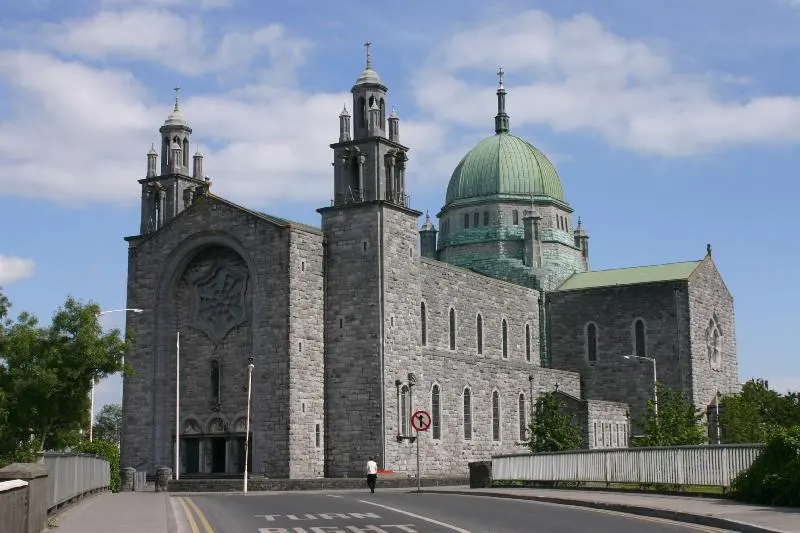
Unknown authorUnknown author, CC BY-SA 3.0 via Wikimedia Commons

Galway Cathedral on the 3D model; tap a pin for its page and directions.
Before the cathedral
The diocese managed without a cathedral for over a century. A parish chapel was built around 1750 on Middle Street at Lower Abbeygate Street, and in 1821 it was replaced by a limestone Gothic church dedicated to St Patrick. When the Diocese of Galway was created in 1831, St Patrick's became its pro-cathedral, and it kept that role until the new building opened, after which it was deconsecrated.
Opening day, 15 August 1965
The cathedral was opened on the feast of the Assumption. President Éamon de Valera lit the sanctuary candle, Cardinal Richard Cushing of Boston preached a sermon titled Why Build a Cathedral?, and Bishop Michael Browne of Galway stood at the altar with four archbishops. Browne, who died in 1980, was the first bishop buried in the building; three earlier bishops were reinterred in its crypt.
The building and its critics
The architect was John J. Robinson, who had designed many churches in Dublin and around the country. The dome and pillars are Renaissance in spirit; the rose windows and mosaics draw on the wider tradition of Christian art. The dome rises 44.2 metres, and the whole is built almost entirely of local limestone, which makes it, by most reckonings, the last stone public building in Ireland.
The client wanted a traditional building at a time when many thought a 1950s cathedral should look like the 1950s. In 1966, on The Late Late Show, a Trinity College student named Brian Trevaskis called it a ghastly monstrosity, and an Irish Times piece on ugly Irish buildings later described it as a squatting Frankenstein's monster. Galwegians have largely made their peace with it.
Mass, music and the organ
Mass is celebrated every day: a vigil at six on Saturday evening; Sunday Masses at nine, in Irish, at half past ten, at half past twelve and at six; and on weekdays and holy days at eleven and six. The adult choir has sung at the major ceremonies since the dedication and at the half-past-ten Mass on Sundays, with a repertoire from the sixteenth century to the twenty-first, Gregorian chant and Irish traditional music included.
The gallery organ was built by Rushworth and Dreaper of Liverpool in 1966 and rebuilt and much enlarged by the Irish organ-builder Trevor Crowe in 2006 and 2007; it has three manuals and 59 speaking stops and is heard in the summer concert series as well as at services. A smaller one-manual instrument serves the side chapels.
Questions people ask
When was Galway Cathedral built?
What are the Mass times at Galway Cathedral?
How tall is the dome?
Who designed Galway Cathedral?
Written from Wikipedia, "Cathedral of Our Lady Assumed into Heaven and St Nicholas, Galway" (CC BY-SA 4.0), read on 2026-09-19, and from the OpenStreetMap places on the model. Nothing has been added from memory; follow the source for its footnotes.