Galway City Museum
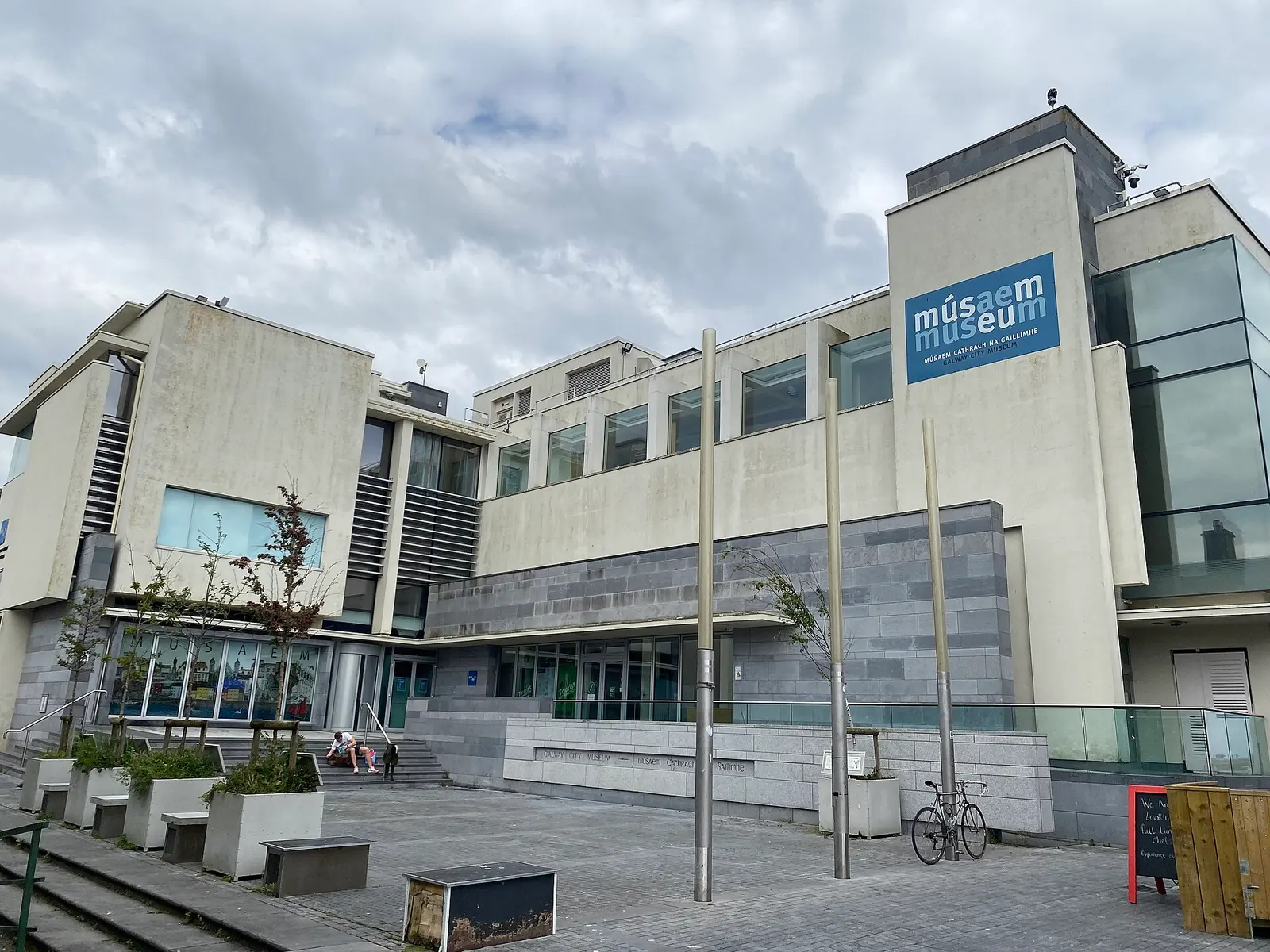
The city's museum is the three-storey building of glass and stone that stands right behind the Spanish Arch, on the bank of the Corrib where the fish market used to be. It opened in April 2007, replacing a much smaller museum that had lived in a house beside the arch since 1976, and it holds the things the city could not bear to throw away: the carved stones of the merchants' houses, the mayor's sword and mace, a Claddagh shawl, the statue that used to sit in Eyre Square.
Checked against the source on 2026-09-19.
瑞丽江的河水, CC BY-SA 4.0 via Wikimedia Commons

Galway City Museum, The Quays, Ard Bia at Nimmo's on the 3D model; tap a pin for its page and directions.
From Comerford House to a new building
The museum began in 1976 in Comerford House, a private house of about 1800 that the Comerford family gave to the city. The sculptor and writer Clare Sheridan, a first cousin of Winston Churchill, had lived there from 1948 to 1954 and had collected medieval stones from around the city; that collection was the seed. Curators Etienne Ryan, Michael Keaney, Bill Scanlan and Jim Higgins built it into a general collection of folk life, industry and militia. Part of the display was inside the Spanish Arch itself. That first museum closed in 2004.
The new building went up behind Comerford House on the initiative of Galway City Council, to a design by Ciaran O'Connor and Ger Harvey of the Office of Public Works. It is L-shaped and kept to three floors so as not to overwhelm the streets around it, and it makes a small square between itself and the arch that the city uses for events. Finished in 2006 at a cost of 6.89 million euro, with 2,100 square metres of floor, it won its architects the Bank of Ireland Opus award that year, and opened to the public in April 2007. In 2010 it received designated status under the National Cultural Institutions Act, which lets it keep archaeological finds on behalf of the State.
What the collection holds
The medieval stone collection is the heart of it: carvings and architectural fragments, mostly from sixteenth- and seventeenth-century Galway, including chimney pieces, corbels, armorial plaques and heraldic panels, two complete fireplaces and the Atty Doorway of 1577. One fireplace, dated 1615, came from the Slate House nunnery on Kirwan's Lane; the other carries the arms of the Lynch and Henry families from a house on High Street. Many of these stones are all that survives of buildings the Tribes of Galway lived in.
The D. J. Murphy collection has more than three hundred farm and industrial implements, mostly from the county, with rare straw work from rural life. The militia collection remembers the Connaught Rangers and the Galway men who served from the Crimea to the two world wars. The Claddagh collection keeps the apron and shawl of the fishing village and a model of its layout in the early twentieth century, and there is a maritime collection besides.
On loan: the sword, the mace and the paintings
The civic sword dates from the charter of James I, which in 1610 allowed it to be carried before the mayor; the mace was made in Dublin in 1710 and given to the town in 1712 by Mayor Edward Eyre, the man Eyre Square is named after. The Daly collection lends twenty-four paintings and four sculptures, with work by John Constable, Paul Henry, John Lavery, Roderic O'Conor, Walter Osborne, George Russell, Leo Whelan and Jack B. Yeats.
Here too is a rare copy of the pictorial map of 1651, printed by the Galway Archaeological and Historical Society in 1901; the royal arms of George III from the old courthouse that is now the Town Hall Theatre; and Albert Power's statue of Pádraic Ó Conaire, moved indoors from Eyre Square. The National Museum of Ireland lends finds from the Galway city excavations of 1987 to 1998, including coins of Philip II of Spain and Elizabeth I.
The exhibitions
The permanent rooms run from Routes to the Past, on prehistoric Galway, through Galway Within the Walls, on the medieval city, to Pádraic Ó Conaire: Man and Statue, Dance Hall Days, Cinema in Galway, and Galway and the Wars of Empire. Touring shows have included Jack B. Yeats, Between Art and Industry, and Water and Life, on the people, boats and places of the water. The museum sits at the bottom of Quay Street, with the Long Walk and the Claddagh across the river.
Questions people ask
Where is Galway City Museum?
When did the museum open?
What is the most important thing in the museum?
Is the Pádraic Ó Conaire statue in the museum?
Written from Wikipedia, "Galway City Museum" (CC BY-SA 4.0), read on 2026-09-19, and from the OpenStreetMap places on the model. Nothing has been added from memory; follow the source for its footnotes.