The Spanish Arch
At the bottom of the old town, where the Corrib meets the sea, two stone arches stand at the end of a stretch of wall. The bigger one is the Spanish Arch, An Póirse; its neighbour is the Blind Arch, An Póirse Caoch. They are what is left of the Ceann an Bhalla, the Front Wall, and the name that draws the crowds is not the one they were born with.
Checked against the source on 2026-09-19.
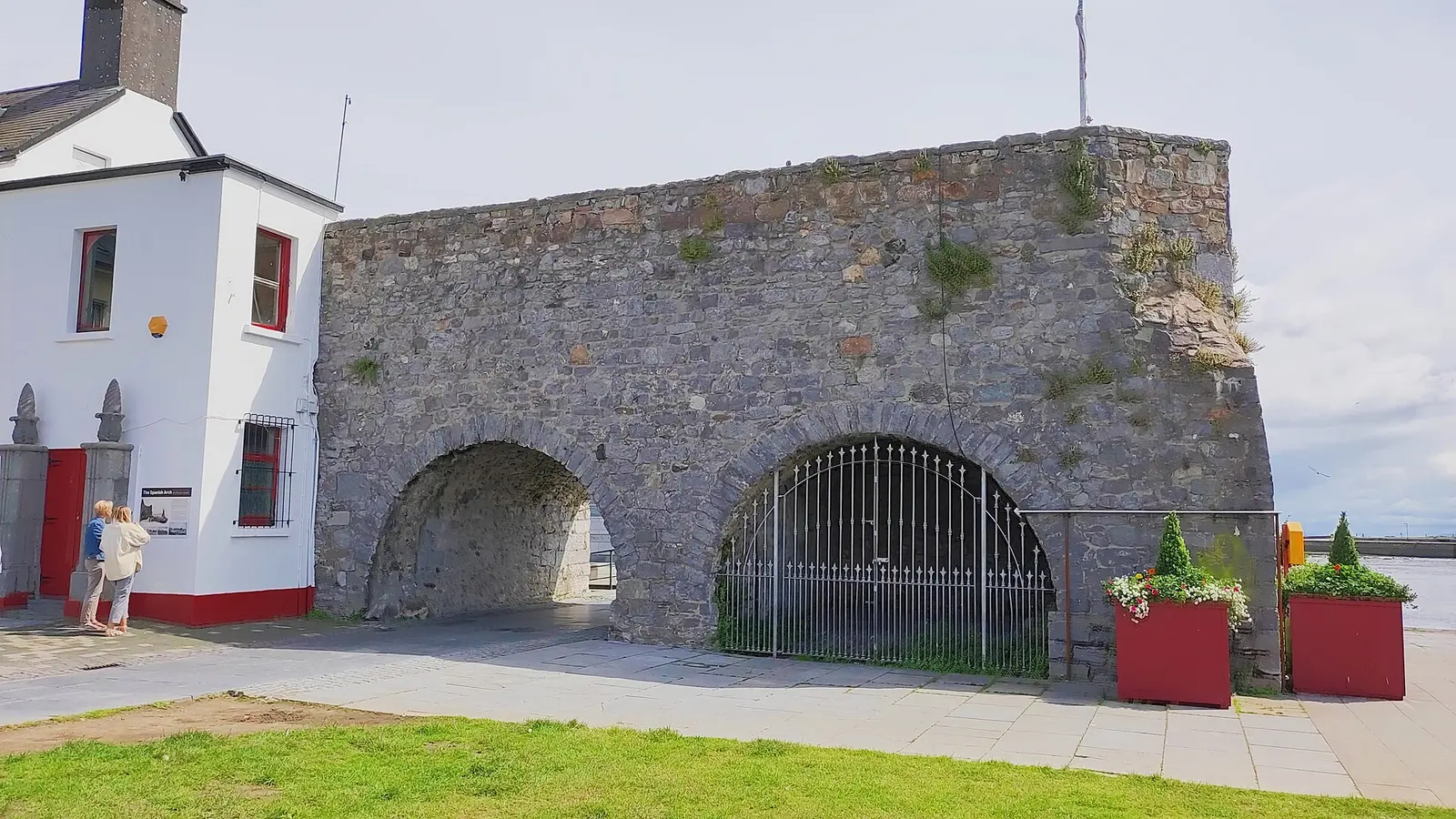
Josi, CC BY-SA 4.0 via Wikimedia Commons

Galway City Museum, The Quays on the 3D model; tap a pin for its page and directions.
A wall to protect the quays
In 1584, under Mayor Wylliam Martin, the city wall was extended from Martin's Tower down to the bank of the Corrib. The purpose was to shield the quays in the area then called the Fish Market, now Spanish Parade. That extension was the head of the wall, ceann an bhalla, and the two arches belong to it.
The Eyres, the Long Walk and a borrowed name
In the eighteenth century the Eyre family of Eyrecourt, the same family as the mayor of Eyre Square, extended the quays with a new promenade, the Long Walk, and made the arches so that people could pass from the town to it. The word Spanish is not from that period at all; when it was built the opening was most likely known as the Eyre Arch.
In 1755 the earthquake that destroyed Lisbon sent a tsunami up the Atlantic coast, and it partly destroyed the arches. What stands today is what survived and was repaired.
The museum and the films
Until 2006 part of the arch housed the Galway City Museum. The museum then moved into a purpose-built home directly behind the arch, where it is now. The arch itself appears in several films set in Galway, among them The Rising of the Moon of 1957.
The Long Walk runs along one side of the arches, a line of painted houses facing the water that has become one of the most photographed views in the city. From the arch it is a ten-minute walk up Quay Street and Shop Street to Eyre Square; the model above pins the museum, the pubs and restaurants on the quays and the route between them.
Questions people ask
Why is it called the Spanish Arch?
How old is the Spanish Arch?
Where is the Galway City Museum?
Written from Wikipedia, "Spanish Arch" (CC BY-SA 4.0), read on 2026-09-19, and from the OpenStreetMap places on the model. Nothing has been added from memory; follow the source for its footnotes.