Eyre Square
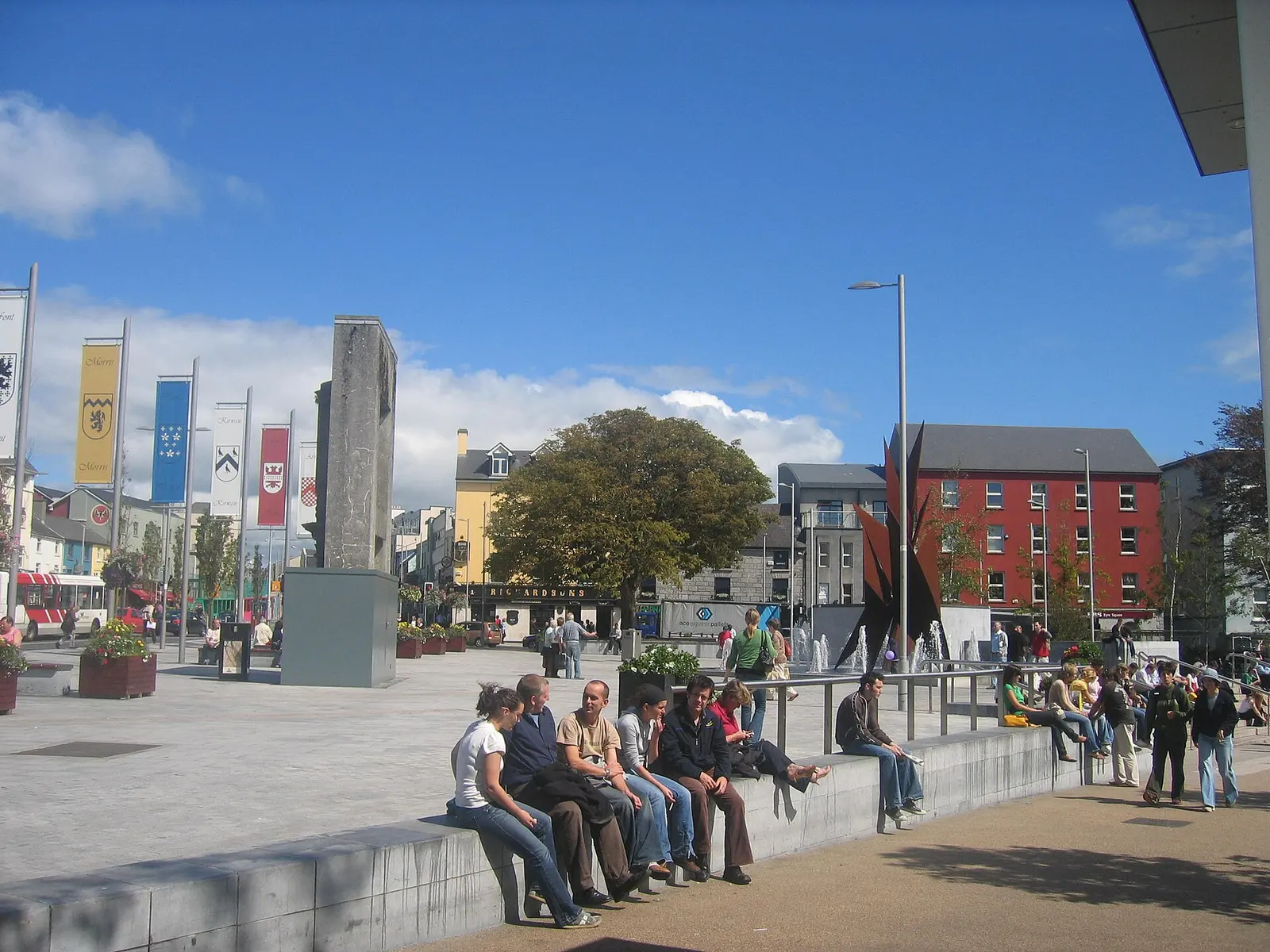
Every road into the centre of Galway arrives at Eyre Square, the rectangular park that the Irish call An Fhaiche Mhór, the big green. The railway station is on one side, the shopping streets start at another, and the buses gather along the third. It has carried the name of a mayor since 1710, has been a market, a walled Georgian garden and a memorial park, and it was pedestrianised on its western side in 2006.
Checked against the source on 2026-09-19.
Sulmac (talk) (Uploads), public domain via Wikimedia Commons

Eyre Square, The Browne Doorway, Padraic O'Conaire Statue, Kennedy Park Playground, Eyre Square Centre on the 3D model; tap a pin for its page and directions.
From the town gate to Mayor Eyre
The square began as the open ground in front of one of the medieval town gates, the Green, where the markets were held, mostly at its northern end. The first attempt to enclose it is recorded in 1631, when ash trees were planted and a wooden fence put up. In 1710 Mayor Edward Eyre formally presented the land to the city, and his name has stayed on it.
In 1801 General Meyrick built a stone wall around it, and for a time it was Meyrick Square. The middle of the nineteenth century brought a Georgian redesign of the whole park. It is sometimes, though rarely, called John F. Kennedy Memorial Park.
The statue that went into the river
In September 1873 a statue of Ulick de Burgh, Lord Dunkellin, who had sat as a Liberal MP for Galway borough and then the county, was unveiled in the park. The 1,600 pounds it cost were raised within three months, partly through donations and partly through pressure on the tenants of his father, Lord Clanricarde of Portumna. The sculptor was John Henry Foley.
On 25 May 1922 the Galway Town Tenants' League took the statue down, paraded it through the streets and threw it into the River Corrib. The 1960s rebuilding removed the iron railings, which went to the yard of St Nicholas' Collegiate Church.
What stands in the square today
The Browne Doorway is the oldest thing here: the original doorway of the Browne family's house of 1627 on Lower Abbeygate Street, moved to the square in 1905 and now reinforced and cased in plexiglass after years of neglect. A statue of the Irish-language writer Pádraic Ó Conaire was put up in 1935, and there is a portrait bust of John F. Kennedy.
The statue of Liam Mellows, a leader of the War of Independence, went up in 1957 in the car park east of the Browne Doorway. At the northern end fly the banners of the fourteen Tribes of Galway, the merchant families who ran the city's trade and politics from the thirteenth century to the nineteenth. Before the last, contested relandscaping the park also held two cast-iron cannons, given in recognition of the Connaught Rangers' service in the Crimean War.
Around the square
The square is the hinge of the city. William Street and Shop Street lead off its south-west corner towards the river; the station and the Hardiman Hotel close the east side; the streets on the other three sides carry most of the traffic into the centre. On the model above, the square's own places are pinned: the playground in the park, the doorway, the statue, and the shops, cafés and hotels that face it.
Questions people ask
Why is it called Eyre Square?
What is the Browne Doorway?
What are the flags in Eyre Square?
Is Eyre Square near the train station?
Written from Wikipedia, "Eyre Square" (CC BY-SA 4.0), read on 2026-09-19, and from the OpenStreetMap places on the model. Nothing has been added from memory; follow the source for its footnotes.