The Tribes of Galway
Galway calls itself the City of the Tribes, and its roundabouts carry the names in Irish on navy signs. The Tribes were fourteen merchant families who ran the town's trade with the continent and its council for six centuries: Athy, Blake, Bodkin, Browne, Darcy, Deane, Font, French, Joyce, Kirwan, Lynch, Martin, Morris and Skerrett. Twelve were Anglo-Norman by origin; the Darcys and Kirwans were Irish families who had taken Norman ways.
Checked against the source on 2026-09-19.
Eoin Gardiner, CC BY 2.0 via Wikimedia Commons

Lynch's Castle, Eyre Square, Galway City Museum, The Browne Doorway on the 3D model; tap a pin for its page and directions.
Merchants against the hinterland
The families grew rich on trade with Europe and kept the municipal government to themselves through the Middle Ages and after. They set themselves apart from the Gaelic people of the country around the town, though many of them spoke Irish as a second or even a first language. The fear of losing their common faith brought merchants and Gaels together as Irish Catholics after the rebellion of 1641, and in the Confederate wars of 1641 to 1653 Galway sided with the Catholic Confederation.
That choice cost them everything. After the Cromwellian conquest the town was besieged, and when it surrendered in April 1652 the New Model Army confiscated the Tribes' property. They never recovered the power they had held.
Names you still meet
The Lynches gave Galway its second mayor, Dominick Dubh Lynch, in the 1480s, a mayor of Bordeaux and a peer of France, and an Argentinian ancestor of Che Guevara; their fortified house is still on Shop Street. Richard Joyce, of the Joyces, is credited with the Claddagh ring. The Kirwans produced Richard Kirwan, president of the Royal Irish Academy, and Joseph Kirwan, first president of Queen's College Galway. Richard Martin of the Martins founded the Society for the Prevention of Cruelty to Animals; Edward Martyn was the playwright of Tulira. Michael Morris, Lord Killanin, was president of the International Olympic Committee from 1972 to 1980.
The Brownes had the doorway that now stands in Eyre Square and a Marquess of Sligo; the Skerretts gave two archbishops of Tuam; the Blakes a Spanish general of the Peninsular War; the Darcys the lawyer who wrote the constitution of Confederate Ireland. Michael Bodkin, who died young in 1900, was the model for Michael Furey in James Joyce's The Dead.
The Tribes in the city today
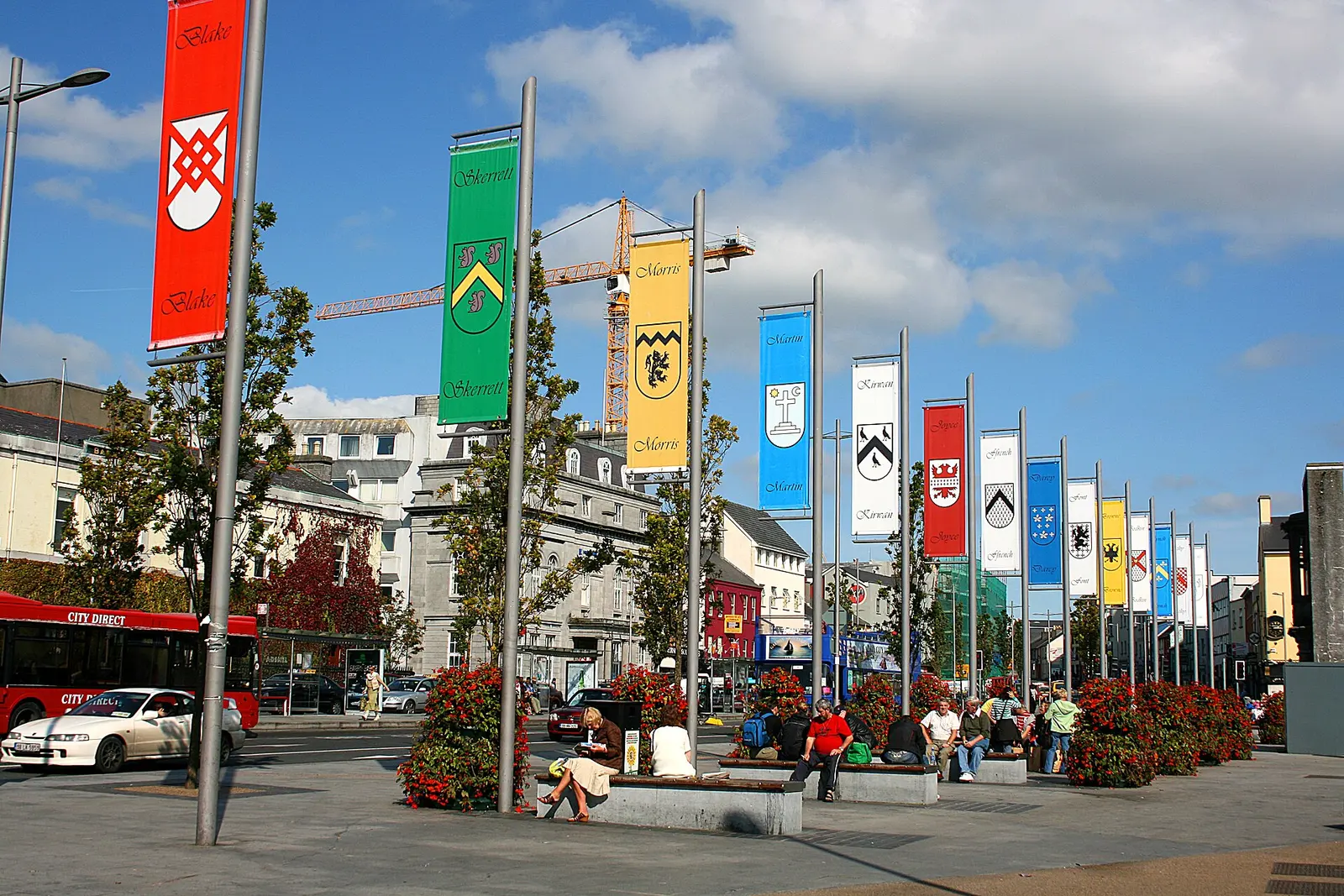
The people of the city and county are the Tribesmen, as the county's GAA teams are called. Banners for the fourteen families fly at the northern end of Eyre Square, and fourteen roundabouts around the city are named for them. The stones of their houses, fireplaces, plaques and doorways, are in the City Museum behind the Spanish Arch; Lynch's Castle and Blake's Castle are the two townhouses still standing.
Questions people ask
Who were the Tribes of Galway?
What are the names of the 14 Tribes?
Why are Galway's roundabouts named after the Tribes?
Written from Wikipedia, "Tribes of Galway" (CC BY-SA 4.0), read on 2026-09-19, and from the OpenStreetMap places on the model. Nothing has been added from memory; follow the source for its footnotes.