The Claddagh
Across the Wolfe Tone Bridge from the Spanish Arch, where the Corrib opens into the bay, lies the Claddagh, An Cladach, the seashore. It was a fishing village outside the city walls, with its own customs and its own king, and its boats supplied the fish market at the Spanish Arch until the end of the nineteenth century. The thatched cottages are gone, but the name went round the world on a ring.
Checked against the source on 2026-09-19.
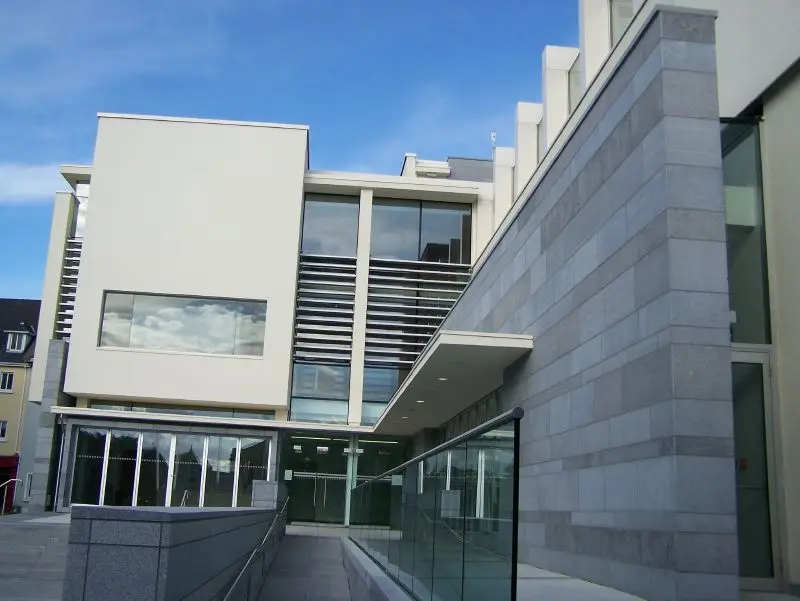
Shane.Halloran at English Wikipedia, public domain via Wikimedia Commons

Claddagh Basin, Claddagh Hostel, Galway City Museum on the 3D model; tap a pin for its page and directions.
The village and its end
The original Claddagh was a cluster of thatched cottages on the shore just outside the old walls, facing the quays. In the 1930s the whole village was razed and replaced with a council housing scheme, which is what stands there now: neat streets of houses running back from the water, with the swans on the basin in front.
The ring
The Claddagh ring comes from here. Two hands hold a crowned heart; the hands are friendship, the heart love, the crown loyalty. It is worn as a friendship ring and a wedding ring by people of Irish descent everywhere, and how it is worn, which hand and which way the heart points, is said to tell whether the wearer is spoken for.
The Claddagh today
The area has a national school, a community centre, a Catholic church and the new Claddagh Arts Centre. Its people have included the Gaelic footballer Bobby Beggs, who played for Dublin and then Galway; Thomas Grady, who won the Victoria Cross in the Crimea; Sean Cannon of The Dubliners, who was born here; and President Catherine Connolly, who settled in the Claddagh after her marriage. From the Spanish Arch it is a five-minute walk over the bridge; the Long Walk faces it across the water.
Questions people ask
Where is the Claddagh in Galway?
What does the Claddagh ring mean?
Are the old Claddagh cottages still there?
Written from Wikipedia, "Claddagh" (CC BY-SA 4.0), read on 2026-09-19, and from the OpenStreetMap places on the model. Nothing has been added from memory; follow the source for its footnotes.