The Aran Islands
Three limestone islands close the mouth of Galway Bay: Inishmore, the largest, with Kilronan and its harbour; Inishmaan in the middle; Inisheer, the smallest, nearest Clare. Together they are 46 square kilometres of the Burren's rock set in the Atlantic, laced with 1,600 kilometres of stone walls, home to 1,347 people who speak Irish, and crowned by Dún Aonghasa on its hundred-metre cliff.
Checked against the source on 2026-09-19.
Guilhem Boyer, CC BY-SA 3.0 via Wikimedia Commons

Dún Aonghasa Visitor Centre, Teampall Bheanáin, Church of St Thomas, Dún Conchúir on the 3D model; tap a pin for its page and directions.
Getting there
Four sounds divide the islands from the mainland and each other: the North Sound between Inishmore and Lettermullen, Gregory's Sound between Inishmore and Inishmaan, the Foul Sound between Inishmaan and Inisheer, and the South Sound between Inisheer and Clare. Aran Island Ferries sail all year from Rossaveal, with a bus from Galway city; a seasonal ferry runs from Doolin from April to October; a cargo boat goes from Galway harbour several times a week. Aer Arann Islands flies from Connemara Airport at Inverin to Inishmore, with a bus from the city. On the islands the speed limit is 50 km/h, cars are exempt from roadworthiness tests, and most visitors hire a bike or, increasingly, an e-bike.
Rock, soil and weather
The islands are Viséan limestone, laid down in a tropical sea about 350 million years ago and full of fossil corals, crinoids, urchins and ammonites, scoured by the last ice age into one of the finest glacio-karst landscapes anywhere. There is no natural topsoil: the first settlers made fields with seaweed and sand and walled them against the wind. Storm waves have thrown boulders fifty metres above the sea on the western cliffs. The climate is mild, from about 15 degrees in July to 6 in January, and because grass grows above 6 degrees the islands share the Burren's long growing season; arctic, alpine and Mediterranean plants grow side by side, with gentians and avens peaking in late May and orchids later. Rare butterflies and the Burren green moth live here.
Forts, saints and Synge
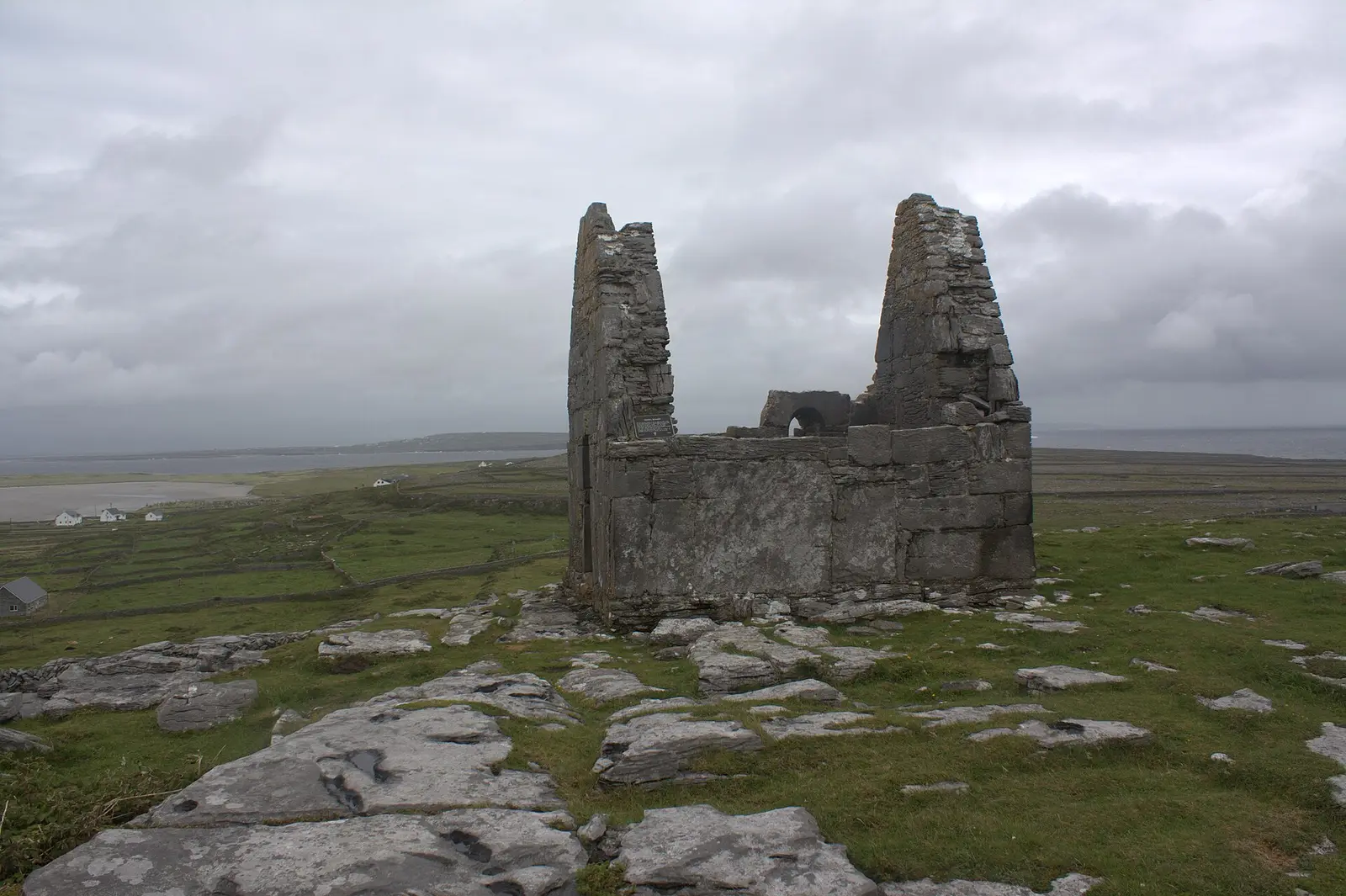
Seven prehistoric stone forts stand on the islands: Dún Aonghasa on Inishmore, built from about 1100 BC, Dún Chonchúir on Inishmaan and the rest. Enda founded his monastery at Killeany in 490, the first true monastery in Ireland, and a dozen followed on Inishmore alone; Brendan was blessed here before his voyage, and Columba called Aran the Sun of the West. Teampall Bheanáin is held to be the smallest church in the world, set north to south. The O'Briens built a castle on Inisheer's ringfort in the fifteenth century; the O'Flahertys took it in 1582 and Cromwell's soldiers wrecked it. There are 38 national monuments in all.
J. M. Synge wrote his journal The Aran Islands here, published in 1907, and found the plot of The Well of the Saints at a holy well; Lady Gregory came to learn Irish; Seán Keating painted here every year; Harry Clarke spent six summers on Inisheer. Liam O'Flaherty was born at Gort na gCapall on Inishmore in 1896, and the poet Máirtín Ó Direáin came from the same island. Man of Aran was filmed in 1934, Father Ted's Craggy Island borrowed the wreck of the Plassy for its titles, and Martin McDonagh set The Cripple of Inishmaan here. The Aran jumper is the islands' famous export, though many sold here are knitted elsewhere; the tarred canvas currach is their boat.
Questions people ask
How do you get to the Aran Islands from Galway?
Which is the biggest Aran island?
Do people speak Irish on the Aran Islands?
How old is Dún Aonghasa?
Written from Wikipedia, "Aran Islands" (CC BY-SA 4.0), read on 2026-09-19, and from the OpenStreetMap places on the model. Nothing has been added from memory; follow the source for its footnotes.