Inishmore
The boats from Rossaveal come into Kilronan, the harbour village of an island that is a slab of the Burren set down in the mouth of Galway Bay. Inishmore, Árainn in Irish and the only legal name under the Official Languages Act, is 31 square kilometres, home to 820 people at the 2016 census, and second in size among Irish islands only to Achill. Its stone forts, above all Dún Aonghasa, have drawn visitors since George Petrie called it the most magnificent barbaric monument in Europe.
Checked against the source on 2026-09-19.
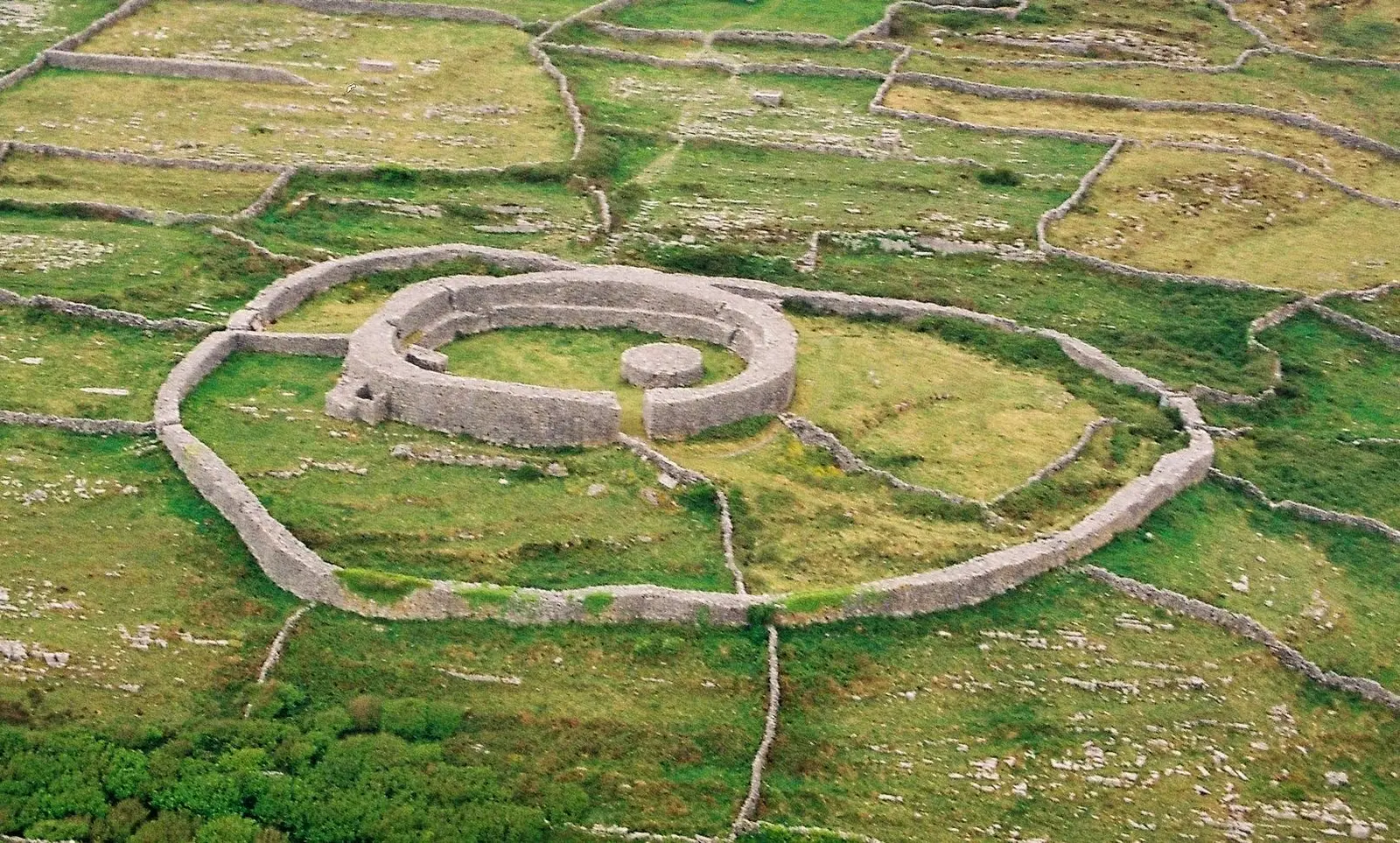
Ronan Mac Giollapharaic, CC BY-SA 4.0 via Wikimedia Commons

Dún Aonghasa, Poll na bPéist, Dún Eochla, Dún Dúchathair, Cliffs of Aran, Dún Eoghanachta on the 3D model; tap a pin for its page and directions.
A name the Ordnance Survey made
Before the twentieth century the island was Árainn or Árainn Mhór, a name thought to mean a kidney shape or a ridge, and it was anglicised as Aran or Great Aran. Inishmore was apparently coined by the Ordnance Survey for its 1839 map as a rendering of Inis Mór, the big island, with no sign of use before then. During the Cromwellian conquest the island was a prison camp for Catholic priests who defied the banishment decree of 1653; the last were released after the Restoration in 1662.
Limestone, grikes and gentians
The island is an extension of the Burren: limestone pavement from the Visean stage of the Carboniferous, 330 to 350 million years old, split by grikes into blocks called clints, with fossil corals and crinoids in the stone, and scoured by the last ice sheet. The grikes shelter dwarf shrubs, the shattered pavement carries Arctic and alpine plants, and where a skin of soil covers the rock there is grass with gentians and orchids, the same odd mix as the Burren.
Villages, forts and the Wormhole
Fourteen villages run the length of the island, from Cill Rónáin and Cill Éinne in the east through Mainistir, Cill Mhuirbhigh and Fearann an Choirce to Eoghanacht in the west. Visitors get about by minibus, bicycle or pony trap; there is a museum on Dún Aonghasa and its possible uses, and the Aran Sweater Market has its own museum of the sweater. On the southern coast Poll na bPéist, the Wormhole, is a natural pool so nearly rectangular that it has hosted the Red Bull Cliff Diving World Series; it connects to the sea through underground channels. Passenger ferries sail from Rossaveal and Doolin, and Aer Arann Islands flies daily to Connemara Airport. Martin McDonagh set The Lieutenant of Inishmore here and filmed The Banshees of Inisherin on the island; The Matchmaker and Leap Year were shot here too.
Questions people ask
How do you get to Inishmore?
How many people live on Inishmore?
What is Poll na bPéist?
What is the correct name, Inishmore or Árainn?
Written from Wikipedia, "Inishmore" (CC BY-SA 4.0), read on 2026-09-19, and from the OpenStreetMap places on the model. Nothing has been added from memory; follow the source for its footnotes.