Dún Aonghasa
At the western end of Inishmore, where the island ends in a cliff a hundred metres above the Atlantic, four rings of dry stone wall close on the edge. Dún Aonghasa, Dun Aengus, is the best known of the prehistoric forts of Aran and one of the most important archaeological sites in Ireland; people have stood on its innermost wall and looked straight down at the sea for three thousand years.
Checked against the source on 2026-09-19.
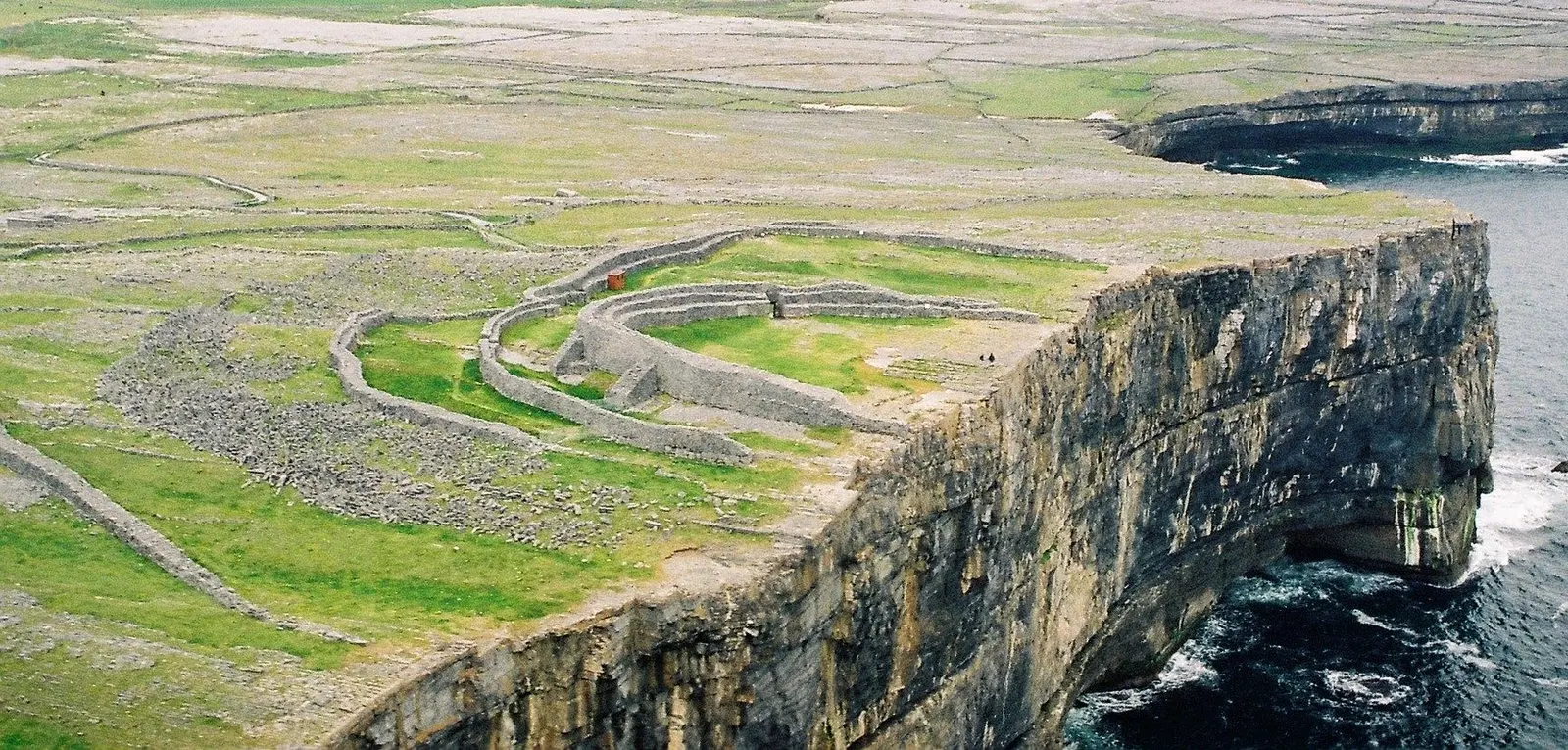
Ronan Mac Giollapharaic, CC BY-SA 4.0 via Wikimedia Commons

Dún Aonghasa Visitor Centre, Kilmurvey Craft Village on the 3D model; tap a pin for its page and directions.
Three thousand years of building
The first enclosure goes back to about 1100 BC, rubble piled against big upright stones; signs of people living here, and moulds for casting bronze, date from around 900 BC, the end of the Bronze Age. The triple walls on the western side were probably built about 500 BC. An early Iron Age brooch in the shape of a bird's head was found in a wall in 1839. T. F. O'Rahilly argued it was built in the second century BC by the Builg after the Laginian conquest of Connacht. The name means the fort of Aonghas, perhaps the pre-Christian god.
What stands on the cliff
Four concentric walls of dry stone, up to four metres thick in places, on a cliff that was once far from the sea: when the fort was built the water was lower and a documentary has estimated the edge a thousand metres away, so the original plan was probably oval or D-shaped, and part of it has fallen into the ocean. Outside the third wall a field of limestone spikes set upright or leaning outward in the fissures, a cheval de frise, survives largely intact; the only other in the region is at Ballykinvarga in Clare. A huge rectangular stone slab inside has no known purpose.
The walls have been rebuilt to six metres, with wall walks, chambers and flights of steps; the restoration is easy to tell from the old work by its mortar. A small museum at the foot of the hill tells the fort's story, and nearby are a Neolithic tomb and a heritage park with a thatched cottage and a poteen still. Dún Dúchathair, the black fort, Dún Eoghanachta and Dún Eochla are the other forts on Inishmore, and Dún Chonchúir stands on Inishmaan.
Questions people ask
How old is Dún Aonghasa?
How high is the cliff at Dún Aonghasa?
How far is Dún Aonghasa from Kilronan?
Written from Wikipedia, "Dún Aonghasa" (CC BY-SA 4.0), read on 2026-09-19, and from the OpenStreetMap places on the model. Nothing has been added from memory; follow the source for its footnotes.