Alcock and Brown at Clifden
At about a quarter to two on the afternoon of 14 June 1919 a converted Vickers Vimy bomber lifted off Lester's Field in St John's, Newfoundland. The next morning it came down nose-first in a bog at Derrygimlagh, south of Clifden, beside the Marconi wireless station, and John Alcock and Arthur Whitten Brown had made the first non-stop flight across the Atlantic. They sent word of their success to London from the Marconi station, and King George V knighted them at Windsor a week later.
Checked against the source on 2026-09-19.
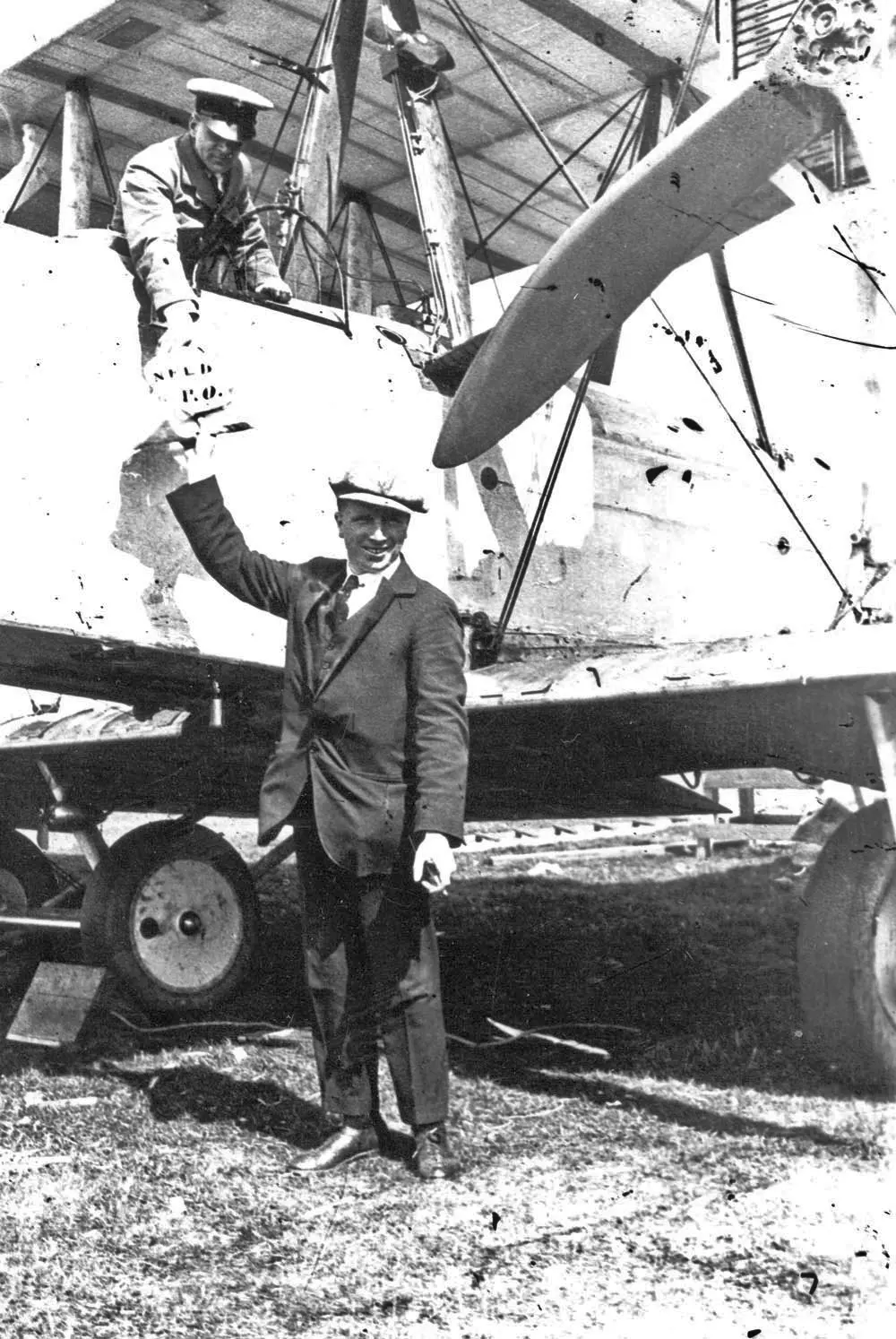
Holloway, public domain via Wikimedia Commons

Alcock and Brown Atlantic Crossing, Alcock and Brown Crash Site, Marconi Wireless Station Site, Marconi Wireless Radio Station on the 3D model; tap a pin for its page and directions.
The men and the machine
Alcock, born in Manchester in 1892, had his pilot's licence by November 1912, raced at Hendon before the war, flew a Handley Page bomber and was a prisoner in Turkey after being shot down over the sea. Brown, born in Glasgow to American parents in 1886, was the navigator. Their Vimy had two Rolls-Royce Eagle engines of 360 horsepower, with a Rolls-Royce team under Eric Platford on hand in Newfoundland, and it carried two toy cat mascots, Alcock's called Lucky Jim, and nearly 200 letters, the first transatlantic airmail. The rival Handley Page team under Admiral Mark Kerr was still testing when Vickers's crew assembled their aircraft and went.
The prize and the memorials
Winston Churchill, as Secretary of State for Air, presented the Daily Mail's 10,000 pounds, offered for the first crossing by aeroplane in under 72 hours; a US Navy flying boat had crossed two weeks earlier with six stops over 23 days and did not qualify. Alcock died six months later, on 18 December 1919, in a crash near Rouen; Brown lived until 1948. A cairn stands on the Marconi site four kilometres south of Clifden, about 500 metres from where they landed, and a sculpture of an aircraft tail fin on Errislannan Hill, two kilometres north of the landing place, was dedicated on the fortieth anniversary in 1959. In 1979 an RAF Phantom repainted in commemorative colours flew the route again for the sixtieth. The model on this page pins the landing and crash sites and the Marconi station.
Questions people ask
Where did Alcock and Brown land?
How long did the Alcock and Brown flight take?
Where is the Alcock and Brown memorial?
Written from Wikipedia, "Transatlantic flight of Alcock and Brown" (CC BY-SA 4.0), read on 2026-09-19, and from the OpenStreetMap places on the model. Nothing has been added from memory; follow the source for its footnotes.