Connemara
Ask where Connemara ends and you will start an argument. The wide definition takes everything west of Lough Corrib and Galway city out to Killary Harbour, Galway Bay and the ocean; the narrow one keeps only the old territory of the Conmhaicne Mara in the far north-west, around Clifden, its main town. Either way it holds the biggest Irish-speaking district in the country, the Twelve Bens, and a history of clans, landlords and a hard war.
Checked against the source on 2026-09-19.
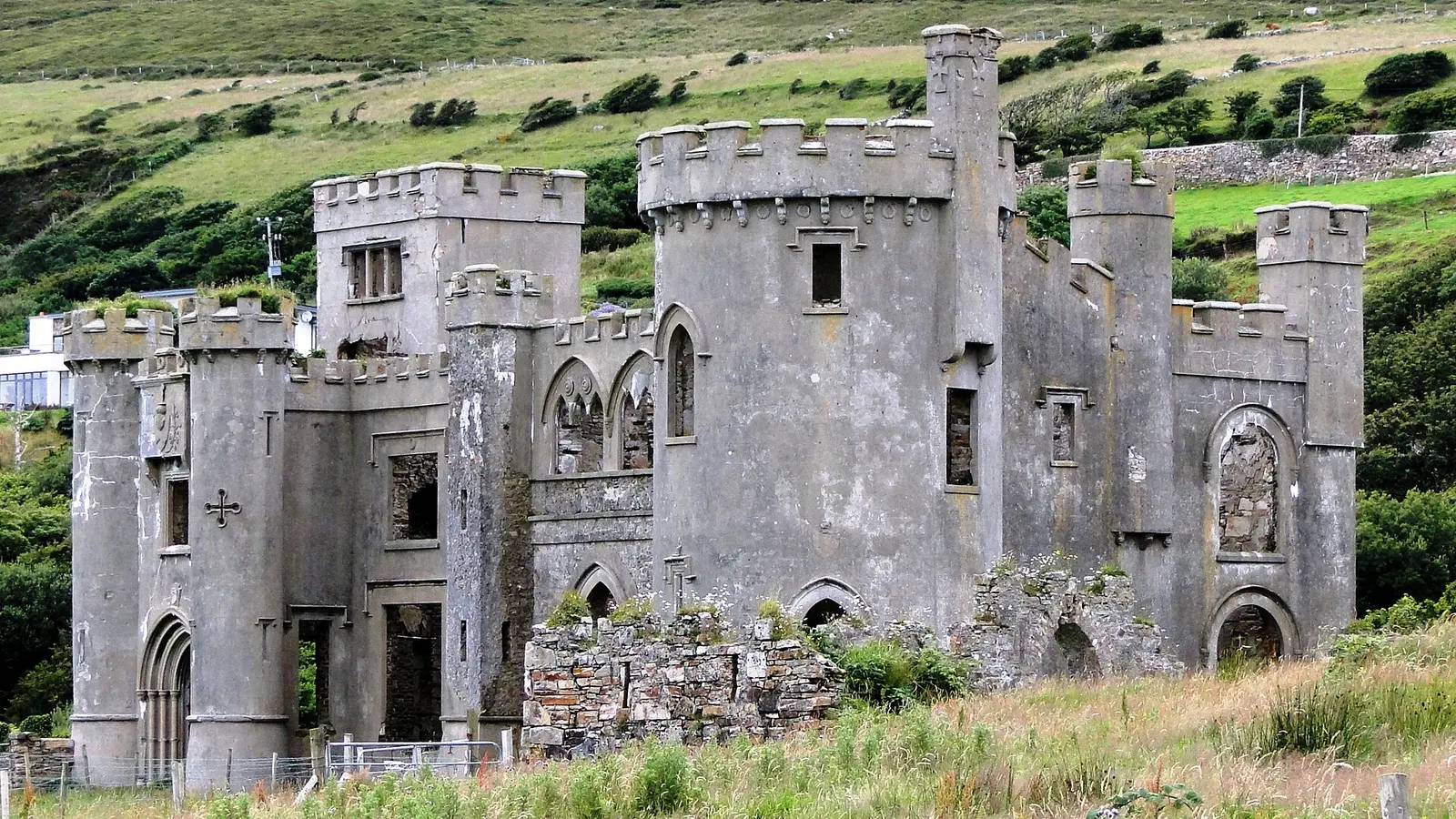
Drow69, CC BY-SA 3.0 via Wikimedia Commons

Clifden Castle, Kylemore Abbey, Connemara National Park Visitor Centre, Marconi Wireless Station Site on the 3D model; tap a pin for its page and directions.
The name and the boundary
The Conmhaicne were an early tribal group with branches across Connacht; the one that lived by the sea became the Conmhaicne Mara, and from them the region takes its name. The old division was North and South Connemara, split by the Twelve Bens and the Owenglin River, which reaches the sea at Clifden. On its eastern side the Invermore River into Kilkieran Bay and Loch Oorid are among the markers used. About 32,000 people live in the region, and the enumeration districts of South Connemara have the highest share of Irish speakers in Ireland, with the school-age population the most likely to speak it.
Clans, missions and landlords
Before the Tudor and Cromwellian conquests Connemara was ruled by its clans under a code of honour like that of the Scottish chiefs. The Dominicans had a house about two miles north of Roundstone before the suppression of the monasteries. From the 1840s the Anglo-Irish Blakes, who stayed until the 1920s, were remembered as famously bad landlords and as backers of the anti-Catholic Irish Church Missions, whose work caused lasting bitterness; local folklore answered with the rapparee Scorach Ghlionnáin. Green marble outcrops on a line between Streamstown and Lissoughter and was traded here in prehistoric times.
The war in the hills
In the War of Independence the IRA had companies from Maam and Clonbur round to Carraroe, Rosmuc, Letterfrack and Renvyle, while the RIC held fortified barracks at Clifden, Letterfrack, Leenane, Clonbur, Rosmuc and Maam. Thomas Whelan of Connemara was tried and hanged after Bloody Sunday for a killing he denied, and Clifden was burned in reprisal. The West Connemara Brigade's ambush of an RIC convoy at Kilmilkin on 21 April 1921 was seen locally as the fulfilment of an old prophecy that one of the last battles for independence would be fought in those hills. Renvyle House, burned by anti-Treaty forces in the Civil War, was rebuilt by Oliver St John Gogarty as a hotel.
Roads, rails and films
The Midland Great Western Railway branch from Galway to Clifden ran from 1895 to 1935. Today the N59 is the inland road and the R336 the coastal one, the 45 km Connemara Loop, with Bus Éireann and Citylink services and flights to the Aran Islands from Connemara Airport at Minna. Michel Sardou's Les Lacs du Connemara was an international hit in 1981; The Quiet Man, The Field, The Guard, Black '47 and Arracht were filmed here, and Máirtín Ó Cadhain's Cré na Cille and Martin McDonagh's Leenane plays belong to it. Even a region of chaotic terrain on Jupiter's moon Europa is called Conamara Chaos.
Questions people ask
Where exactly is Connemara?
What is the main town of Connemara?
How many people speak Irish in Connemara?
Was there a railway to Connemara?
Written from Wikipedia, "Connemara" (CC BY-SA 4.0), read on 2026-09-19, and from the OpenStreetMap places on the model. Nothing has been added from memory; follow the source for its footnotes.