Connemara marble
The green stone in the jewellers' windows of Clifden comes out of the hills a few miles east. Connemara marble, often just called Irish green, has been quarried since the 1700s, named the national gemstone of Ireland for the colour that ties it to the country, and shipped across Europe and America for columns and floors.
Checked against the source on 2026-09-19.
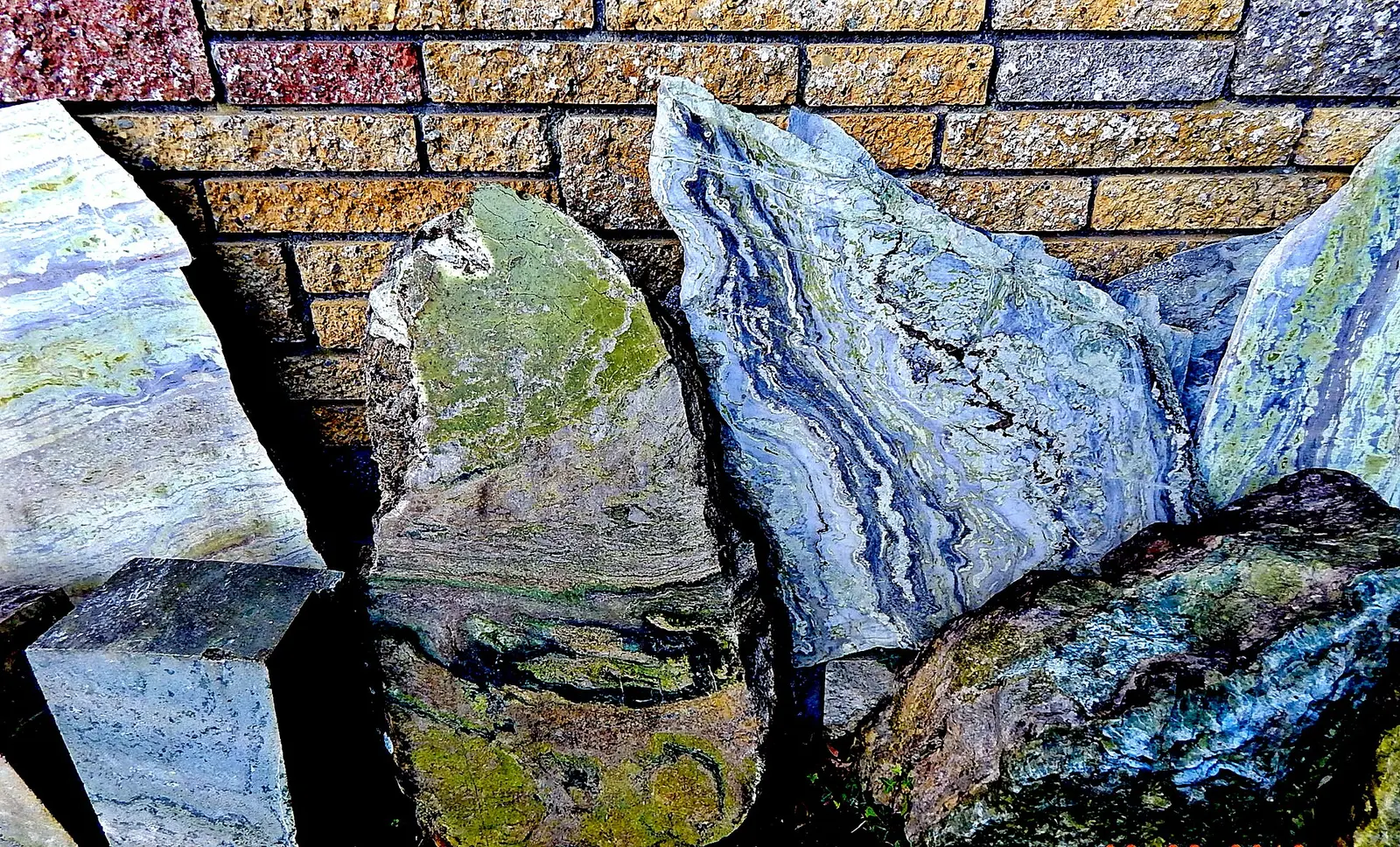
Suzanne Mischyshyn, CC BY-SA 2.0 via Wikimedia Commons

A real marble
It looks like verd antique, the green serpentinite breccia of the Mediterranean, but it is a true marble. Its main minerals are dolomite and calcite, with diopside, serpentine, tremolite, forsterite, clinochlore, phlogopite, omphacite and talc in varying amounts, and it is the serpentine that gives the green. The rock began as limestone mud in the Neoproterozoic and now lies in layers within the Connemara Marble Formation of the lower Dalradian Appin Group, part of the Connemara Metamorphic Complex. The outcrops run along a line from Streamstown to Lissoughter at Recess.
Where it went
The marble weathers fast outdoors and loses its colour, so it is a stone for interiors, souvenirs, jewellery and decoration. A pocket in the Galway quarry yields a rarer variety called Irish Jade, and the walls and door frames of the Senate Chamber of the Capitol in Harrisburg, Pennsylvania, installed in 1901, are done in it.
Questions people ask
Where is Connemara marble quarried?
Why is Connemara marble green?
Can Connemara marble be used outside?
Written from Wikipedia, "Connemara marble" (CC BY-SA 4.0), read on 2026-09-19, and from the OpenStreetMap places on the model. Nothing has been added from memory; follow the source for its footnotes.