Ballybrit Racecourse
The racecourse that gives Galway its biggest week sits in the townland of Ballybrit, just north of the N6, about six kilometres from Eyre Square. The first meeting was run in 1869 and the summer festival still fills seven days, but the ground has also held the largest crowd in the city's history: 280,000 people at Mass with Pope John Paul II on 30 September 1979.
Checked against the source on 2026-09-19.
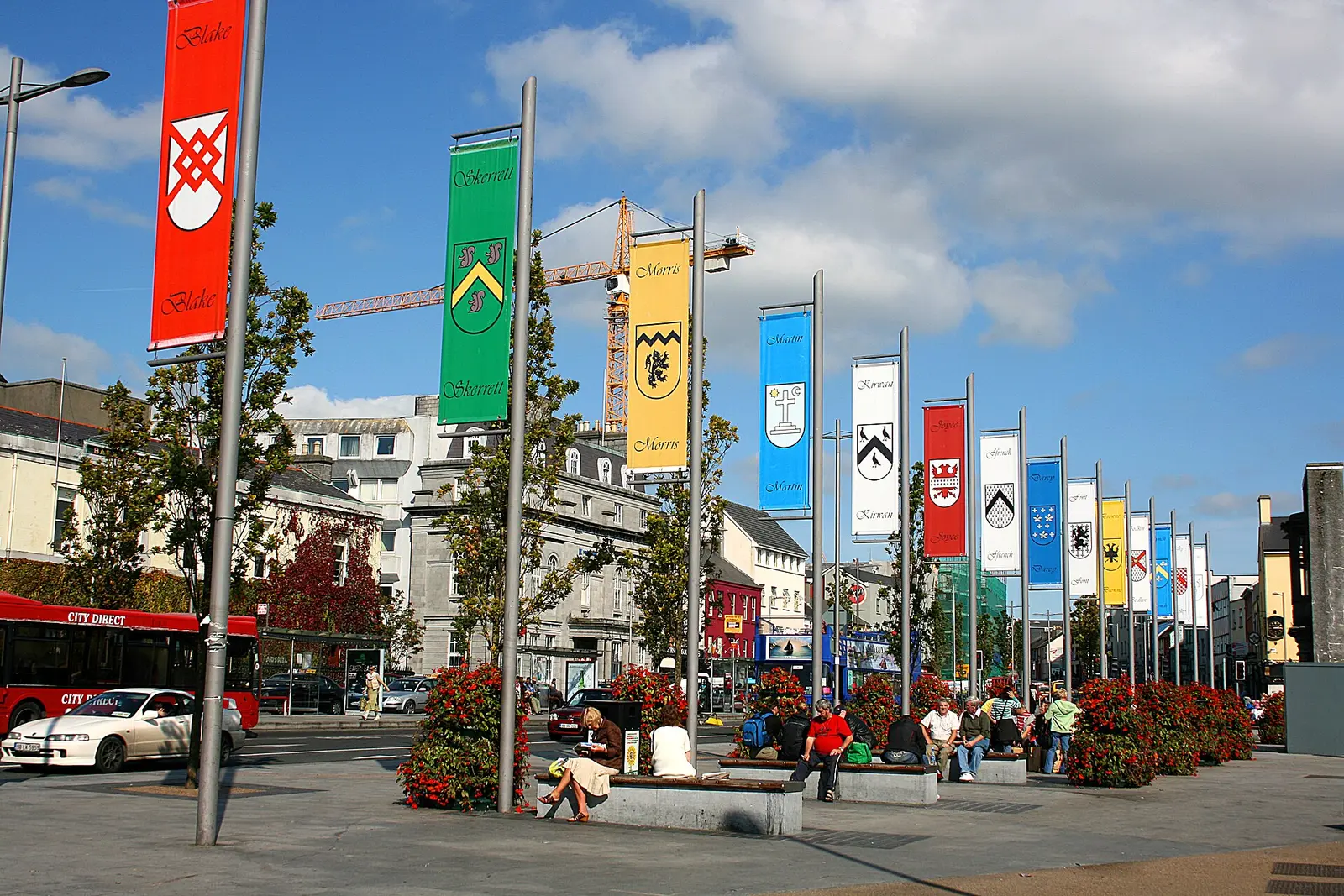
Eoin Gardiner, CC BY 2.0 via Wikimedia Commons

Ballybrit Castle, Eyre Square on the 3D model; tap a pin for its page and directions.
The track
Ballybrit is right-handed, about one mile and three furlongs round, with a steep run down into the dip where the last two fences stand and a sharp climb to the line. The Millennium Stand replaced the old Corrib Stand in 1999; the Corrib was thought to have the longest bar in the world. The Killanin Stand, the main or west stand, opened in 2007 in place of a stand of 1972 and holds 7,000 on its terrace with 700 seats. In November 2024 An Bord Pleanála permitted new temporary stables and ancillary buildings.
The calendar and the crowd
Besides the seven-day festival there are meetings in September over two days, one day in early October and three days on the last weekend of October. When the Pope came in 1979 the Mayor, Micheál Ó hUiginn, gave him the Freedom of Galway on the course, and in 2021 the racecourse served as a mass vaccination centre during the pandemic. The townland itself, 2.5 square kilometres in the parish of St Nicholas, has a medieval tower house and a ringfort used as a graveyard since at least the early 1800s, and the business park next door. The model on this page pins the castle and Eyre Square; the racecourse itself lies beyond the pins.
Questions people ask
Where is Ballybrit Racecourse?
How long is the Galway racecourse?
When are the other Galway race meetings?
Written from Wikipedia, "Ballybrit Racecourse" (CC BY-SA 4.0), read on 2026-09-19, and from the OpenStreetMap places on the model. Nothing has been added from memory; follow the source for its footnotes.