Kylemore Abbey
The grey castle on the lake under the mountain, four kilometres from Letterfrack, is the most photographed building in Connemara. Kylemore was built between 1867 and 1871 as a home for Mitchell Henry, a London doctor with Manchester textile money, and it became an abbey in 1920 when Irish Benedictine nuns, bombed out of Ypres in the First World War, bought it. They are still there, and so are the Victorian walled garden and the Gothic chapel he built for his wife.
Checked against the source on 2026-09-19.
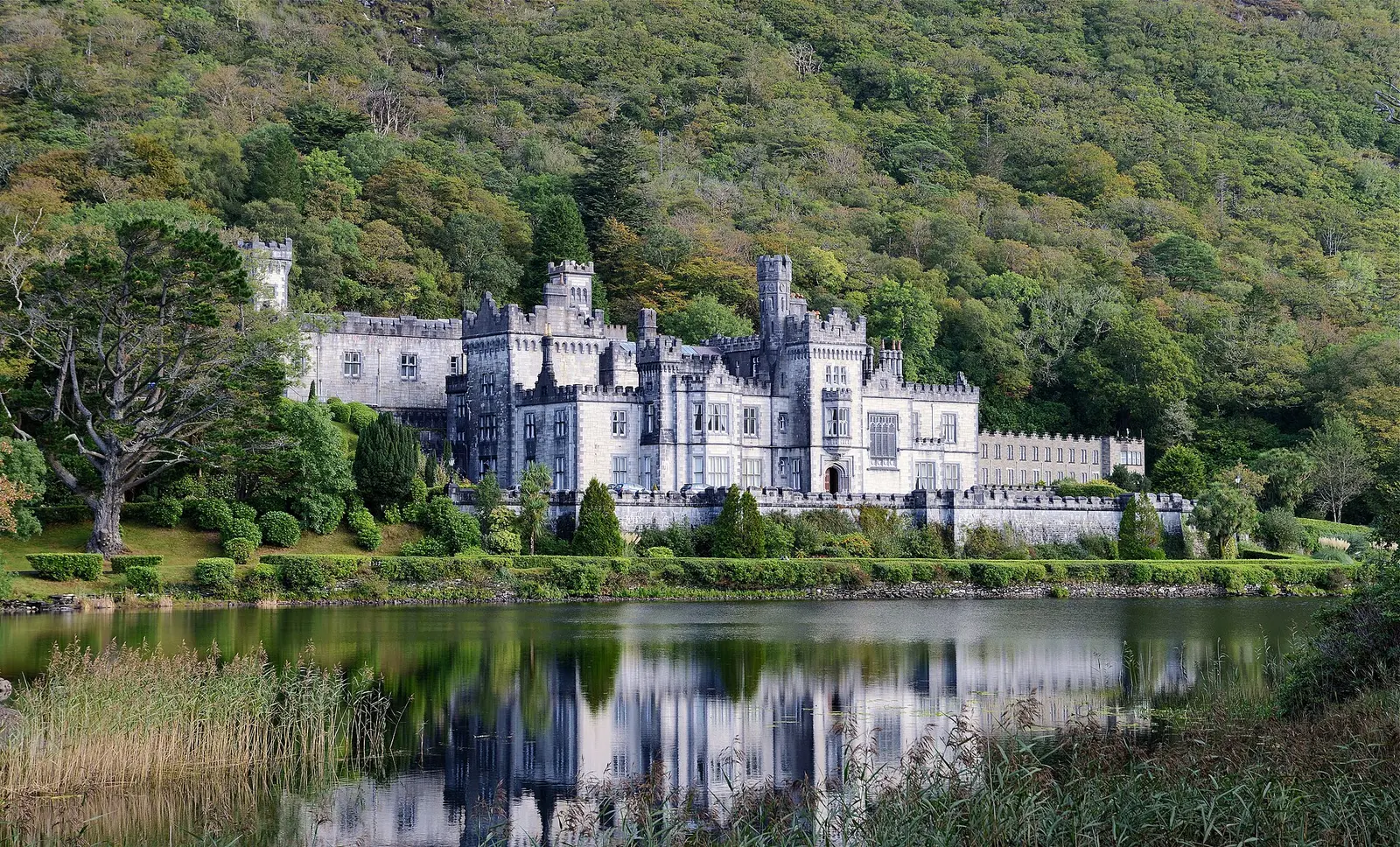
Alvesgaspar, CC BY-SA 4.0 via Wikimedia Commons

Kylemore Abbey, Kylemore Victorian Walled Garden on the 3D model; tap a pin for its page and directions.
A honeymoon and a castle
Mitchell Henry and his wife Margaret came to Connemara on their honeymoon in the mid-1840s and later bought the land; he became MP for County Galway from 1871 to 1885. The castle, designed by James Franklin Fuller with Samuel Ussher Roberts, took a hundred men four years from 1867: about 40,000 square feet, more than seventy rooms, walls two to three feet thick, a 142-foot facade of granite shipped from Dalkey quarry to Letterfrack and limestone brought from Ballinasloe. There were 33 bedrooms, four bathrooms, four sitting rooms, a ballroom, a billiard room, a library, a study, a schoolroom, a smoking room, a gun room and quarters for the butler, cook and housekeeper. Margaret died in 1874 of a fever caught in Egypt; Henry spent less time at Kylemore afterwards and built the Gothic chapel and family mausoleum in her memory.
The nuns of Ypres
The community descends from a Benedictine house founded in Brussels by Lady Mary Percy in 1598, from which houses were founded in Ghent and then Ypres, where the daughters of the Irish nobility went to school and took the veil. When their abbey at Ypres was bombed in the First World War, men of the 8th Battalion of the Royal Munster Fusiliers rescued the nuns, a scene the Freeman's Journal reproduced; they waited out the war in England and bought Kylemore in 1920. They farmed the estate and ran a girls' school, and remain an important employer in the district. Since 2022 the abbey has belonged to the English Benedictine Congregation and is held by the Kylemore Trust for the Irish nation.
The garden, and Notre Dame
The walled Victorian garden, laid out by head gardener James Garnier in 1870 with a kitchen garden and a flower garden, has been open for tours and nature walks since the 1970s; a complete restoration began in 1995, paid for by donations and done by local craftspeople so that the estate could support itself. Since 2015 the University of Notre Dame has run programmes at the abbey, with about a hundred students arriving in 2016, courses in leadership and creative residencies, an outdoor painting class and a flute masterclass by James Galway; a biodiversity programme with the University of Galway began in 2021. Two Fat Ladies cooked dinner for the nuns in 1998, and RTÉ's Nationwide marked their centenary in 2020.
Questions people ask
Is Kylemore Abbey a real abbey?
Who built Kylemore Castle?
Can you visit Kylemore Abbey's gardens?
Where is Kylemore Abbey?
Written from Wikipedia, "Kylemore Abbey" (CC BY-SA 4.0), read on 2026-09-19, and from the OpenStreetMap places on the model. Nothing has been added from memory; follow the source for its footnotes.