St Joseph's Industrial School, Letterfrack
The stone buildings in the middle of Letterfrack that now hold the national furniture college were built for a different purpose. From 1887 to 1974 they were St Joseph's Industrial School, run by the Christian Brothers, and 2,819 boys passed through them, most from far away. What happened to many of them there was set out in 2009 by the Commission to Inquire into Child Abuse, and the village lives with that history.
Checked against the source on 2026-09-19.
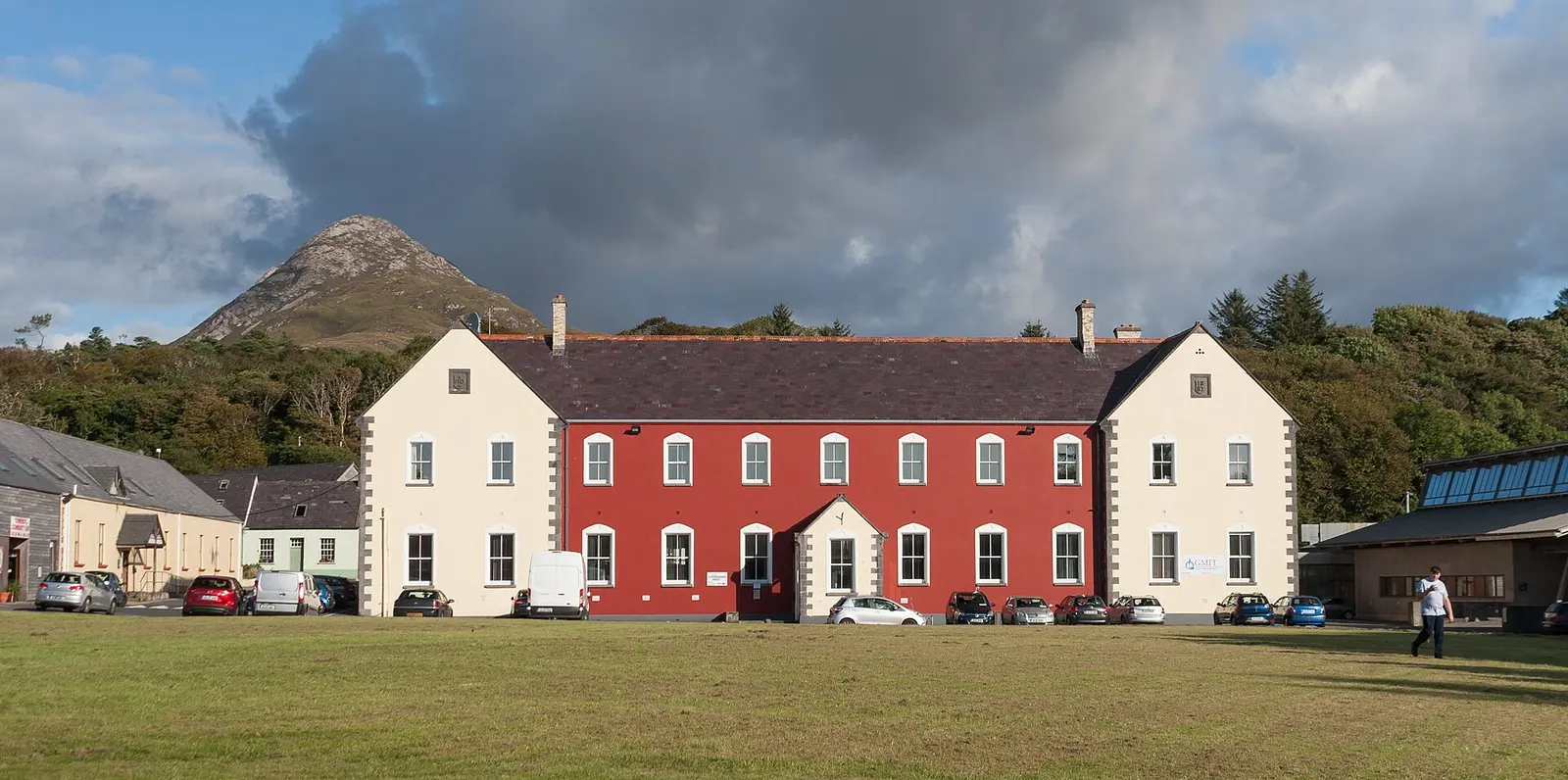
Andreas F. Borchert, CC BY-SA 4.0 via Wikimedia Commons

Connemara National Park Visitor Centre, Diamond Hill Community Centre on the 3D model; tap a pin for its page and directions.
Quakers, missions and Brothers
James and Mary Ellis, a wealthy Quaker couple, bought the land in 1849 and built a school for local children and a house. After they left, the Protestant Irish Church Missions ran the school until 1882. Archbishop John McEvilly of Tuam bought the property in 1884 and told the Lord Lieutenant it was admirably suited for a boys' industrial school; the Lord Lieutenant's advisers doubted there were enough children in the district to fill one, but it was built in 1886 and 1887 to William Hague's designs and opened in 1887.
What the Commission found
The report of 2009 concluded that corporal punishment at Letterfrack was severe, excessive and pervasive, the primary method of control, frequently capricious, unfair and inconsistent, in a climate of fear; no punishment book was kept and the Department of Education was at fault for not requiring one. Sexual abuse by Brothers was a chronic problem: the order sent men already known to have abused boys to the school, did not properly investigate allegations, and followed a policy of protecting the Brothers, the community and the congregation at the expense of the victims. Boys were unprotected in a hostile environment far from their families, taught by poor teachers in bad conditions, and left with little education and no adequate training. Between 1940 and 1970 fifteen children died in the school's care, from tuberculosis among other causes; Brother David Gibson, the provincial, later said that a fuller search of the files showed 100 boys had died over the 86 years. The school's remoteness helped abusers evade scrutiny and was a factor in its closure in 1974.
Those who spoke
Peter Tyrrell told Owen Sheehy-Skeffington about the abuse and wrote a book about the school, published after his death as Founded on Fear; he killed himself in London. Mannix Flynn, the playwright and artist, was a resident, and so was Thomas Dempsey, grandfather of the singer Damien Dempsey, who spent four years there and compared it to Auschwitz. The model on this page pins the village and the national park entrance; the ATU guide describes the furniture college now in the buildings.
Questions people ask
When did Letterfrack Industrial School close?
How many boys died at Letterfrack?
What is in the Letterfrack school buildings now?
Written from Wikipedia, "St Joseph's Industrial School, Letterfrack" (CC BY-SA 4.0), read on 2026-09-19, and from the OpenStreetMap places on the model. Nothing has been added from memory; follow the source for its footnotes.