Liam Mellows
The statue at the top of Eyre Square is of a man who was born in a British army barracks in Lancashire and died in front of an Irish firing squad. Liam Mellows led the only rising outside Dublin of any size in Easter Week 1916, here in County Galway, with some 700 badly armed Volunteers who attacked the police at Oranmore and Clarinbridge and took over Athenry before a warship and troops sent them home.
Checked against the source on 2026-09-19.
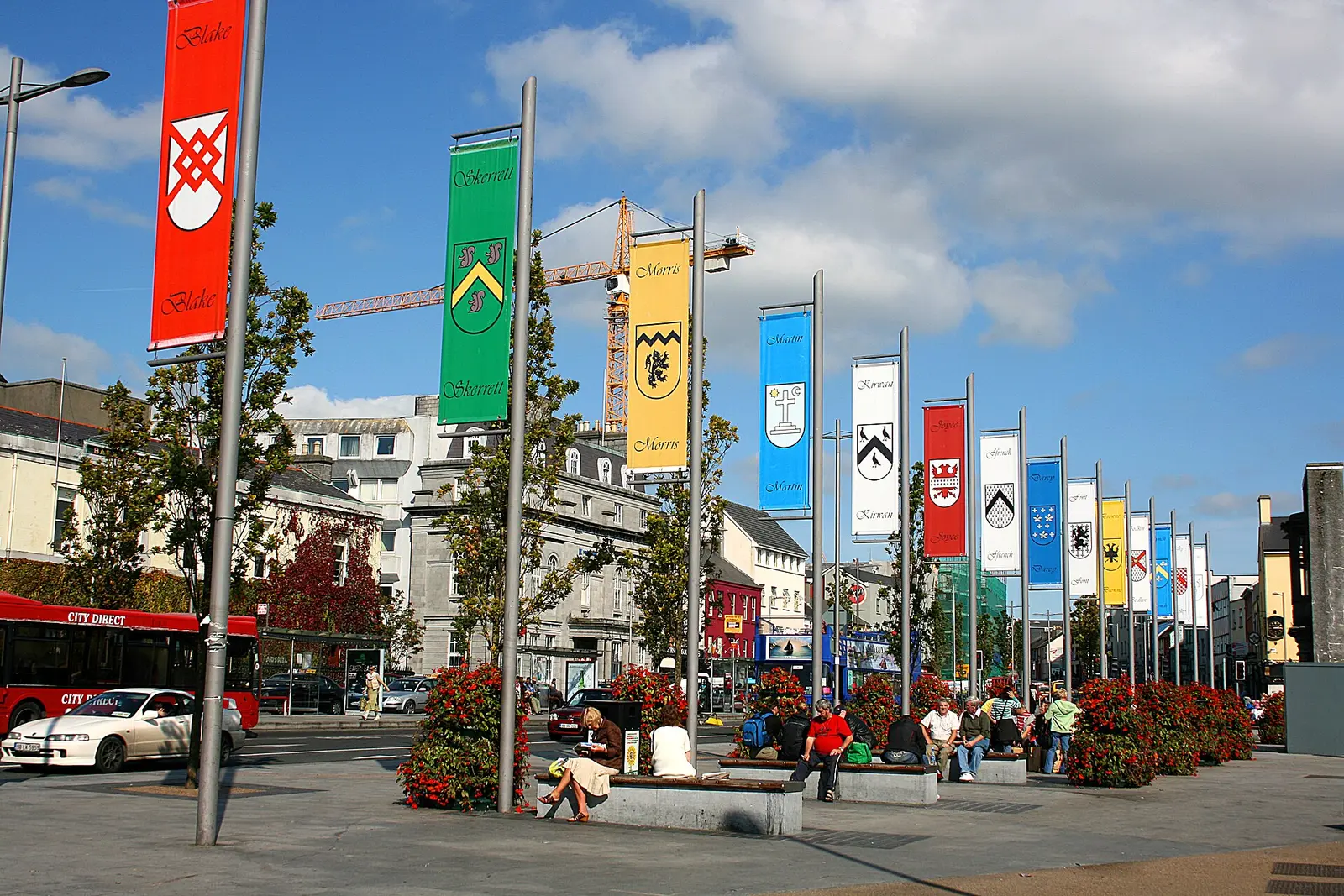
Eoin Gardiner, CC BY 2.0 via Wikimedia Commons

Eyre Square, Renmore Community Centre on the 3D model; tap a pin for its page and directions.
From Ashton-under-Lyne to the IRB
William Joseph Mellows was born on 25 May 1892 at Hartshead barracks in Ashton-under-Lyne, son of an English NCO and Sarah Jordan of Inch, County Wexford. He grew up between Wexford, Cork and Dublin, went to garrison schools and refused a military career. In 1911 a copy of Irish Freedom took him to Thomas Clarke's shop, into Fianna Éireann and, on 7 April 1911, into the Irish Republican Brotherhood; he became an organiser and travelling instructor.
Easter Week in Galway
Escaping from Reading Gaol, he returned to command the Western Division at Easter 1916, leading roughly 700 Volunteers in abortive attacks on RIC stations at Oranmore and Clarinbridge and holding Athenry. His men were very badly armed and supplied and dispersed after a week when British troops and the cruiser Gloucester came west; more than 300 Galway Volunteers were deported to jails in England and Scotland. Mellows fled to the United States, was held without trial in the Tombs in New York on a charge of aiding Germany, worked with John Devoy after his release in 1918 and organised de Valera's fundraising tour of 1919 to 1920 before coming home as the IRA's Director of Supplies.
The Treaty and the firing squad
Elected to the First Dáil, he rejected the Treaty, telling the debates that Ireland should rather be poor and indigent than trade its honour for the fleshpots of Empire, and in April 1922 called the provisional government a chameleon, green, white and orange one moment and red, white and blue the next. Captured when the Four Courts fell in June 1922, he wrote a ten-point programme in jail, state ownership of industry, transport and banks and the confiscation of the large estates, which the Labour Party published after his death. He was executed on 8 December 1922 and buried at Castletown in Wexford. Galway remembers him in the Eyre Square statue, in Dún Uí Mhaoilíosa at Renmore and in the Liam Mellows hurling club; the model on this page pins the square and the barracks.
Questions people ask
What did Liam Mellows do in Galway in 1916?
Where is the Liam Mellows statue?
When was Liam Mellows executed?
Written from Wikipedia, "Liam Mellows" (CC BY-SA 4.0), read on 2026-09-19, and from the OpenStreetMap places on the model. Nothing has been added from memory; follow the source for its footnotes.