Kilmacduagh Monastery
Five kilometres from Gort, on the edge of the Burren, a round tower more than thirty metres tall leans over a field of ruined churches. This is Kilmacduagh, the church of Duagh's son, founded by St Colman in the seventh century on land his cousin King Guaire gave him, important enough by the twelfth century to be the seat of its own diocese, and still the most complete early monastic site in the county.
Checked against the source on 2026-09-19.
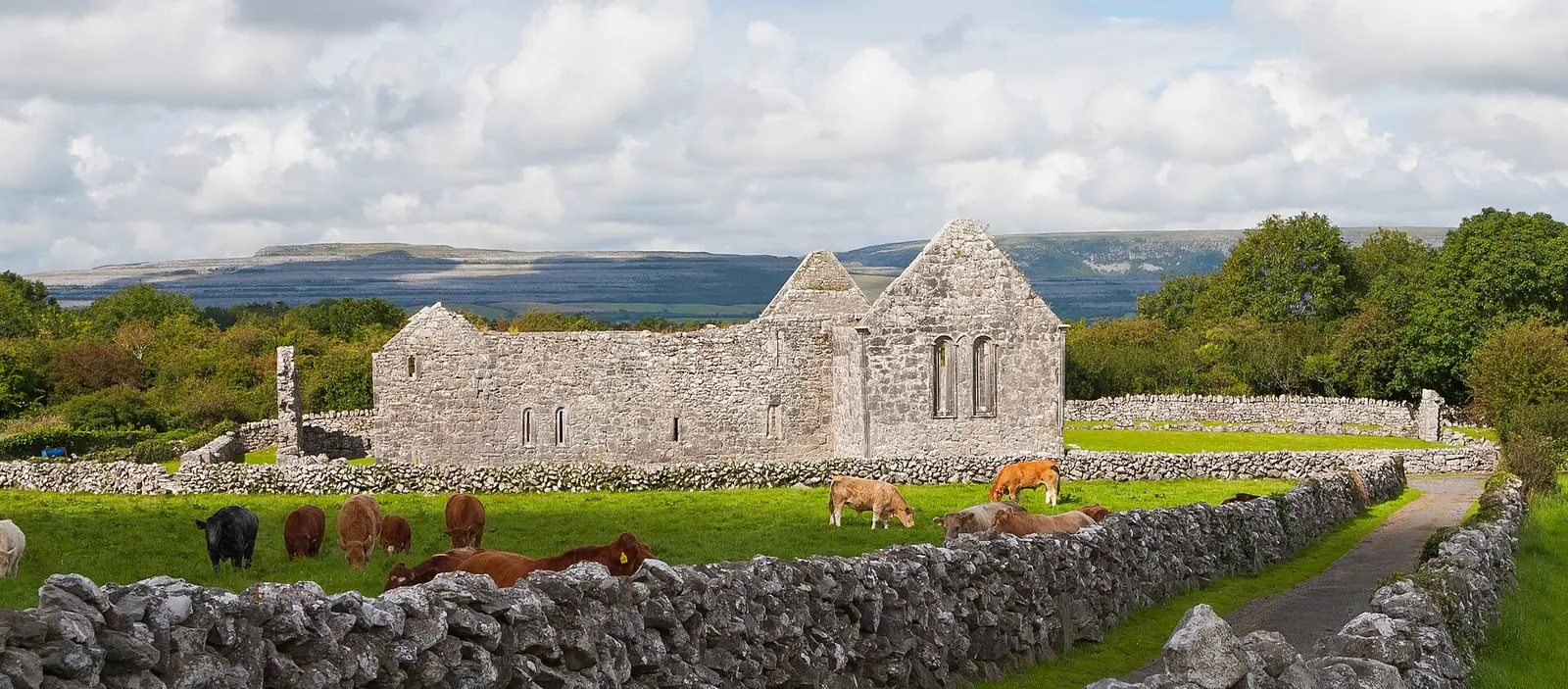
Andreas F. Borchert, CC BY-SA 4.0 via Wikimedia Commons

Kilmacduagh Monastery, Coole Park on the 3D model; tap a pin for its page and directions.
Colman, Guaire and the girdle
The story is that Colman, son of Duagh, was walking in the woods of the Burren when his girdle fell to the ground; he took it as a sign and built his monastery on the spot. King Guaire Aidne mac Colmáin of Connacht, his cousin, who had his fort near where Dunguaire Castle now stands, gave the land. The gem-studded girdle and Colman's crozier were kept by the O'Shaughnessys for centuries; the girdle was lost. Tradition adds that no one in the diocese of Kilmacduagh will die by lightning.
The founding date is uncertain but the early seventh century is likeliest. Colman was abbot and bishop until he died; of his successors only Indrect, who died in 814, is named in the annals before the English came. The annals also record, in 1199, a battle here in which John de Courcy and the English of Ulster and Meath, come to help Cathal Crovderg O'Conor, were routed by Cathal Carragh and pursued to Lough Ree.
The seven churches
People call the ruins the seven churches, though not all were churches and none is as old as Colman. William de Burgh finally wrecked the early monastery in the early thirteenth century, and Owen O'Heyne, who died in 1253, founded the abbey of St Mary de Petra for Augustinian canons in its place; only its later east range can be tied to Bishop Maurice Ileyan, who died in 1283. The buildings are the cathedral, Teampuil Mór, in the graveyard; the Church of Mary east of the road; the Church of St John the Baptist to the north; the abbot's house, Seanclogh; Teampuil Beg Mac Duagh to the south; O'Heyne's Church, the thirteenth-century monastery church, 180 metres north-east; and the round tower fifteen metres south-west of the cathedral.
The tower
The round tower is over thirty metres tall and leans more than half a metre from the vertical, which is what everyone remembers. Deans served the cathedral into the nineteenth century, among them Dudley Persse from 1662 and James Stopford, later Bishop of Cloyne. The site is open, free, in fields beside the road; Coole Park and Thoor Ballylee are on the way back to Gort, and Dunguaire at Kinvara is where the story began.
Questions people ask
Where is Kilmacduagh?
Why does the Kilmacduagh round tower lean?
Who founded Kilmacduagh?
How many churches are at Kilmacduagh?
Written from Wikipedia, "Kilmacduagh monastery" (CC BY-SA 4.0), read on 2026-09-19, and from the OpenStreetMap places on the model. Nothing has been added from memory; follow the source for its footnotes.