Kiltartan
My country is Kiltartan Cross, my countrymen Kiltartan's poor: the airman in Yeats's poem is Lady Gregory's son Robert, and the cross is a real crossroads a few kilometres from Gort. Kiltartan is the barony and parish that held Coole Park, Edward Martyn's Tullira and Thoor Ballylee, and its name comes from a ruined Burke stronghold, Kiltartan Castle, also called Castletown or Ballycastle, which took its own name from the medieval church.
Checked against the source on 2026-09-19.
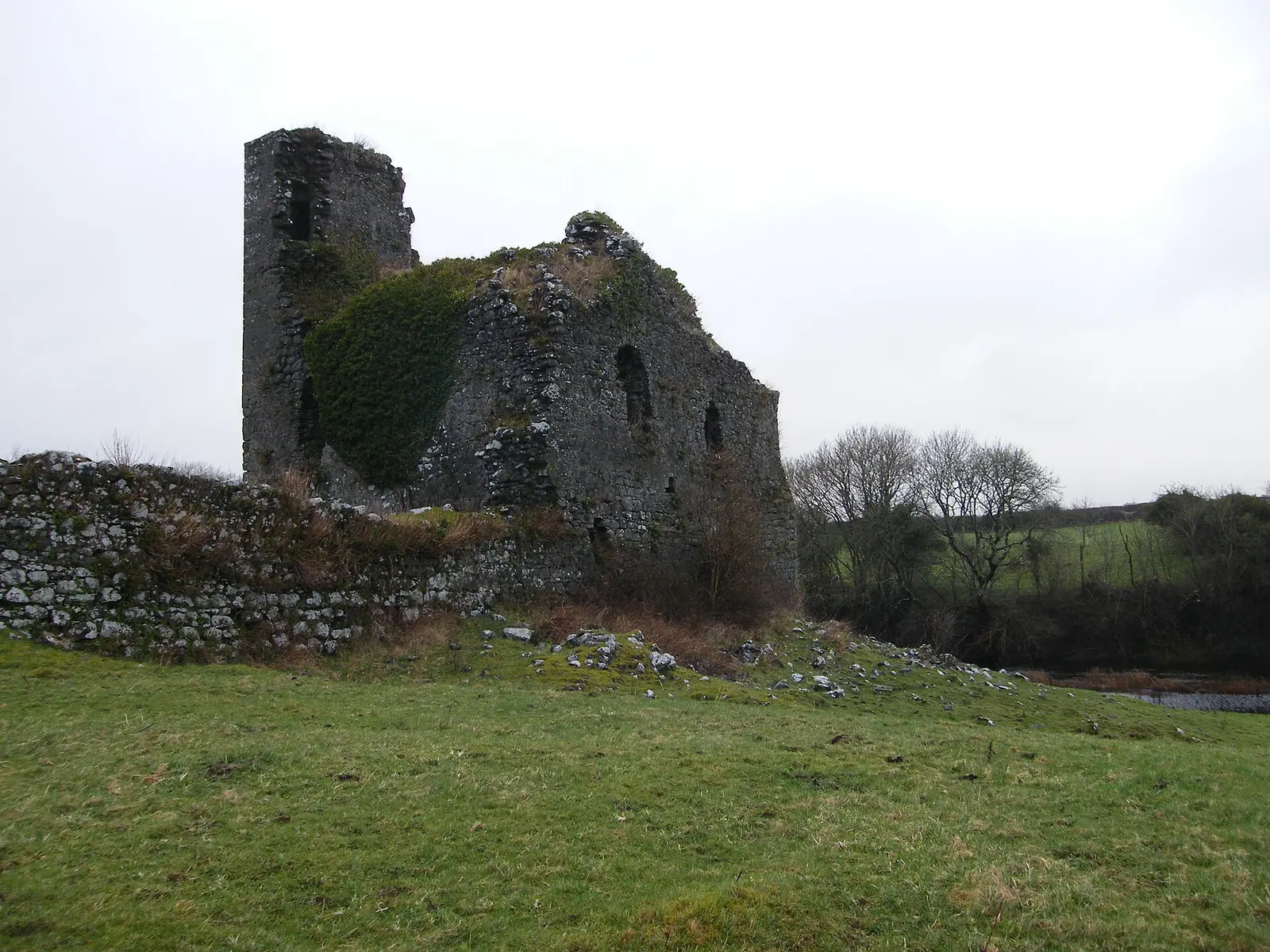
dougf, CC BY-SA 2.0 via Wikimedia Commons

Kiltartan Castle, Coole Park, Thoor Ballylee, Lough Cutra Castle on the 3D model; tap a pin for its page and directions.
Three lordships
The southern part of the barony was Cenél Áeda na hEchtge, O'Shaughnessy's Country, whose castles include Fiddaun near Tubber, a mid-sixteenth-century tower house with an unusually complete inner bawn, most likely built by Sir Roger Gilla Dubh Ó Seachnasaigh, one of four O'Shaughnessy castles and now a national monument on private land in the care of the Office of Public Works. The northern part, Coill Ua bhFiachrach, was the Hynes' territory, and the eastern part, Oireacht Réamoinn, belonged to the Mac Redmonds, a branch of the Burkes.
Kiltartanese
Lady Gregory collected folk tales here for The Kiltartan History Book of 1909 and The Kiltartan Wonder Book of 1910, and wrote her plays in an attempt at the local Hiberno-English that became known as Kiltartanese. The model on this page pins Coole, Thoor Ballylee, Kiltartan Castle and Lough Cutra; the Lady Gregory and Coole Park guides tell the rest.
Questions people ask
Where is Kiltartan?
Why is Kiltartan in a Yeats poem?
What is Fiddaun Castle?
Written from Wikipedia, "Kiltartan" (CC BY-SA 4.0), read on 2026-09-19, and from the OpenStreetMap places on the model. Nothing has been added from memory; follow the source for its footnotes.